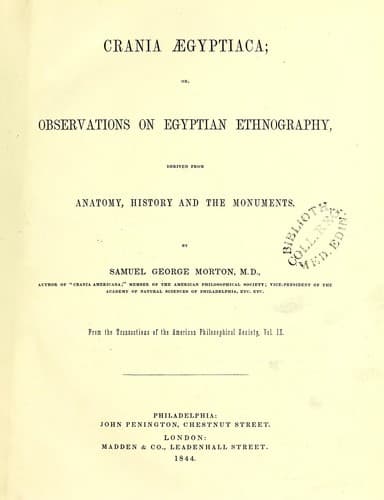
Crania Ægyptiaca: Or, Observations on Egyptian Ethnography Derived from Anatomy, History and the MonumentsMorton, Samuel George
History
Crania Ægyptiaca: Or, Observations on Egyptian Ethnography Derived from Anatomy, History and the Monuments
Morton, Samuel George
Craniology -- Egypt; Ethnology -- Egypt
In my Crania Americana, p. 283, I have described an ingenious method
of measuring the internal capacity of the cranium, devised by my
friend Mr. John S. Phillips. The material used for filling the
skull, as there directed, was white pepper seed, which was chosen on
account of its spheroidal form, and general uniformity of size.
Finding, however, that considerable variation occurred in successive
measurements of the skull, I substituted leaden shot one tenth of an
inch in diameter, in place of the seeds. The skull must be
_completely filled_ by shaking it while the shot is poured in at the
foramen magnum, into which the finger must be frequently pressed for
the same purpose, until the various sinuosities will receive no
more. When this is accomplished, the shot on being transferred to
the tube, will give the _absolute_ capacity of the cranium, or _size
of the brain_, in cubic inches.
Footnote 10:
I have in my possession seventy-nine crania of Negroes born in
Africa, for which I am indebted to Doctors Goheen and M’Dowell,
lately attached to the medical department of the Colony at Liberia,
in western Africa; and especially to Don Jose Rodriguez Cisneros, M.
D., of Havana, in the island of Cuba. Of the whole number,
fifty-eight are adult, or sixteen years of age, and upwards, and
give eighty-five cubic inches for the average size of the brain. The
largest head measures ninety-nine cubic inches; the smallest but
sixty-five. The latter, which is that of a middle-aged woman, is the
smallest adult head that has hitherto come under my notice.
Footnote 11:
Rosellini, M. R. Plate 102, Fig. 47.
Footnote 12:
Idem, M. C. Plate 43, Fig. 45.
Footnote 13:
Rosellini, M. C., Plate 128, Fig. 2.
Footnote 14:
Idem, Plate 101, Fig. 2.
Footnote 15:
Rosellini, M. C. Plate 127.
Footnote 16:
Description de L’Egypte, Antiq. T. I. pl. 68, fig. 114.—HAMILTON,
Ægyptiaca, p. 55.
Footnote 17:
“Dentes vegrandes, et incisorum quoque coronæ crassé cylindricæ
magis aut obtusé conicæ, quam scalpriformes.” _Decas prima_, p. 12.
See also Trans. Royal Soc. of London, 1794.
Footnote 18:
_Prichard_, Researches, Vol. II., p. 250.
Footnote 19:
Ptolemæi Geog. Lib. I., cap. ix., as quoted in Edinburgh Review,
Vol. LX. p. 312.
Footnote 20:
Did any one ever read the EUTERPE for the first time without some
misgivings of this kind? I ask this question with a profound respect
for the venerable historian and traveller.
Footnote 21:
It is a curious fact observed by Rosellini and others, that the
Greeks painted some of their divinities red, as Jupiter and Pan; and
even Venus herself appears to have been sometimes represented of the
same colour. _Monumenti Civili_, II., p. 169.
Footnote 22:
Public-domain text, read in full here on John Shaqi.
Reviews
Reviews
No reviews yet
Be the first to share your thoughts on this work.
Elsewhere in the archive
Join the Discussion
Join the discussion
Sign in to leave a comment or review.
Sign InorCreate an account