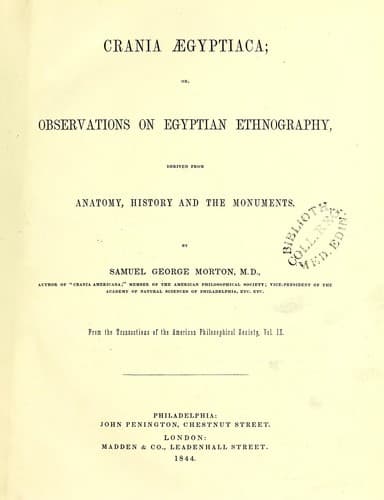
Crania Ægyptiaca: Or, Observations on Egyptian Ethnography Derived from Anatomy, History and the MonumentsMorton, Samuel George
History
Crania Ægyptiaca: Or, Observations on Egyptian Ethnography Derived from Anatomy, History and the Monuments
Morton, Samuel George
Craniology -- Egypt; Ethnology -- Egypt
“By saying that the Egyptians, _for the most part_, are of a
brownish or somewhat brown colour, and of a tanned and blackened
hue, the writer shows that this was not the case equally, at least,
with all of them; and the expression _subfusculi_ and _atrati_ are
very different from _nigri_ or _atri_.”—PRICHARD, Researches, II.,
p. 232.
“Tra le specie d’uomini non affatto neri di pelle, e di fattezze
diversi da quelli che noi siam soliti chiamare Africani, furono gli
antichi Egizi: e quando Erodoto afferma che i Colchi erano una
colonia d’Egitto, perché dessi pure avevano nero colore, non vuolsi
già intende rigorosamente di quel colore, che proprio è dei Neri; ma
tale ci lo chiama per rispetto al colore dei Bianchi e dei Greci
stessi; e perché veramente l’incarnato degli Egiziani al nero in
qualche modo si avvicinava. Noi lo diremmo con più giustezza color
fosco; e questo epiteto diedero anche i Latini agli abitanti
dell’Egitto, come si legge in Properzio: “An tibi non satis est
_fuscis_ Egyptus alumnis?””—ROSELLINI, Mon. Civ., II., p. 167.
Footnote 23:
Lectures on the connexion between Science and Revealed Religion, p.
102, 2d edit.
These remarks will also serve to explain why Aristotle has placed
the Egyptians and Negroes in the same national category; which is
not more surprising than his referring the Thracians to the
Mongolian race, and attributing to them a _red_ complexion.
Footnote 24:
The _longitudinal diameter_ is measured from the most prominent part
of the os frontis, between the superciliary ridges, to the extreme
end of the occiput.
The _parietal diameter_ is measured between the most distant points
of the parietal bones, which are, for the most part, the
protuberances of these bones.
Footnote 25:
I have been engaged for several years past in obtaining and
arranging a series of measurements of the nature here indicated,
under the title of Craniometrical Tables; but it will be readily
conceived that the difficulty of procuring the requisite materials,
renders the progress of such an undertaking extremely slow and
uncertain.
Footnote 26:
I have reason to believe that this cranium, which I obtained
separate from the rest of the mummy, belonged to another Egyptian
skeleton subsequently procured from the same source.
Footnote 27:
Champollion, Monumens de l’Egypte, Tom. II., plate 160, fig. 3.
Footnote 28:
Rosellini, M. C., plate CXXXIII., fig. 3.
Footnote 29:
Hoskins’ Travels in Ethiopia, plate XI.
Footnote 30:
Cailliaud, plate XVI. to XX. For the use of the only copy of this
work now in the United States, I am indebted to the politeness of
Colonel Pleasanton, of this city.
Footnote 31:
Rosellini, Monumenti, M. C., plate CXXXIII.
Footnote 32:
Champollion-Figeac, Egypte Ancienne, p. 356.
Footnote 33:
Public-domain text, read in full here on John Shaqi.
Reviews
Reviews
No reviews yet
Be the first to share your thoughts on this work.
Elsewhere in the archive
Join the Discussion
Join the discussion
Sign in to leave a comment or review.
Sign InorCreate an account