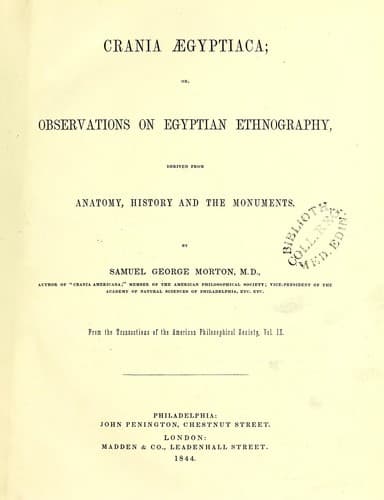
Crania Ægyptiaca: Or, Observations on Egyptian Ethnography Derived from Anatomy, History and the MonumentsMorton, Samuel George
History
Crania Ægyptiaca: Or, Observations on Egyptian Ethnography Derived from Anatomy, History and the Monuments
Morton, Samuel George
Craniology -- Egypt; Ethnology -- Egypt
Since the above note was written, Mr. Gliddon has obligingly
furnished me with the following interesting memorandum: “The name
Nubia, with its derivatives of Nouba and Noubatæ, may be readily
traced to _Noubnoub_, a Nubian divinity in the hieroglyphical
legends of Menepthah I. and Rameses II. and III., and may possibly
be derived from the root _noub_, gold, from the proximity of Nubia
to the Ethiopian gold countries. The word _Berber_, as applied to
the people of Nubia, (now called Berabera in the plural, from
Berberri, the singular,) is without question derived from the
hieroglyphical name _Barobaro_, by which at least one tribe
inhabiting Nubia was known to the Egyptians of the 18th dynasty.”
Footnote 108:
Clot Bey states the present black population of Egypt to be twenty
thousand; and he adds that Negresses form the greater number of
women in almost every harem. Aperçu Générale de l’Egypte, I., p.
329.
Footnote 109:
Sir G. Wilkinson observes that “no difficulty occurred to the
Ishmaelites in the purchase of Joseph from his brethren, nor on his
subsequent sale to Potiphar on arriving in Egypt.” Ancient
Egyptians, I., p. 404.
Footnote 110:
A passage in Manetho establishes at the same time the antiquity and
the power of eunuchs in Egypt; for he relates that king Ammenemes,
of the twelfth dynasty, was slain by them. This event will date, by
the received chronology, upwards of twenty-two hundred years B.C.
Cory, Frag., p. 110. Eunuchs appear, also, to be figured on the
monuments. Vide Rosellini, M. C. III., p. 133.
Footnote 111:
Wilkinson, Ancient Egyptians, II., p. 64.
Footnote 112:
Notwithstanding this mixture of nations, Mr. Hoskins observes, that
the higher classes of modern Ethiopians (Nubians,) pay great respect
to the distinctions of race; that they esteem nothing more than a
light complexion, which the petty kings or chiefs make a
prerequisite to the selection of wives; and that, with this class,
“all mixture with the Negro blood is carefully shunned.”—Travels in
Ethiopia, p. 357.
Footnote 113:
Rosellini, Appendix, No. 13.—Wilkinson, Ancient Egyptians, Vol. III.
Footnote 114:
Hoskins, Travels in Ethiopia. Procession, Part First.
Footnote 115:
Topography of Thebes, p. 136.
Footnote 116:
Champollion, Monumens de l’Egypte, Plate CX.
Footnote 117:
Vide Champollion, Monumens de l’Egypte, Tom. I., Plate LXXI.,
LXXII.; and Rosellini, Monumenti, M. R., Tav. LXXV. A glance at
these illustrations will convince any one that the slave-hunts or
_ghrazzies_, as now practised by the Arabs, Tuaricks and Turks, and
which are so feelingly described by Cailliaud, and by Denham and
Clapperton, were in active operation, with all their atrocities, in
the most flourishing periods of Pharaonic Egypt.
Footnote 118:
Public-domain text, read in full here on John Shaqi.
Reviews
Reviews
No reviews yet
Be the first to share your thoughts on this work.
Elsewhere in the archive
Join the Discussion
Join the discussion
Sign in to leave a comment or review.
Sign InorCreate an account