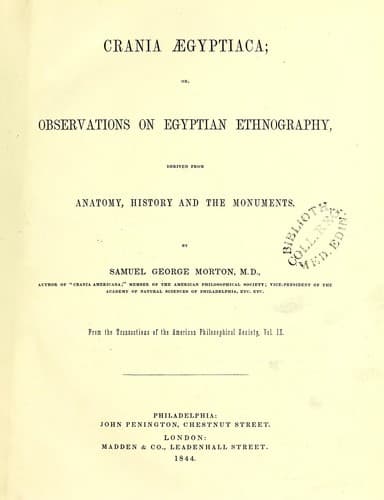
Crania Ægyptiaca: Or, Observations on Egyptian Ethnography Derived from Anatomy, History and the MonumentsMorton, Samuel George
History
Crania Ægyptiaca: Or, Observations on Egyptian Ethnography Derived from Anatomy, History and the Monuments
Morton, Samuel George
Craniology -- Egypt; Ethnology -- Egypt
The opinions of Sir G. Wilkinson are eminently entitled to respect
on all Egyptian questions; and I need not apologize for quoting his
opinions (however they may differ from those just given,) as briefly
expressed in the following passage. “In manners, language, and many
other respects, Egypt was certainly more Asiatic than African; and
though there is no appearance of the Hindoo and Egyptian religions
having been borrowed from one another, which many might be induced
to conclude from their great analogy in some points, yet it is not
improbable that these two nations may have proceeded from the same
stock, and have migrated southward from their parent country in
central Asia.”—Ancient Egypt, Vol. I., p. 3.
Footnote 89:
St. Augustine states that the Punic or Phenician tongue was in _his_
day (the fifth century) a living language, and very like the Hebrew;
and that the _Canaanitish_ language was _mediate_ between the
Egyptian and the Hebrew. Mrs. H. Gray. Hist, of Etruria, p. 124.
Footnote 90:
Transactions of the Royal Society of Literature, Vol. I., p. 140.
Footnote 91:
Appeal to the Antiquarians of Europe on the destruction of the
monuments of Egypt. By George R. Gliddon. p. 27. The portrait of
Atenre-Backhan, another of these Hykshos kings, will be found in
Wilkinson, second series, Plate XXX.
Footnote 92:
Prichard, Researches, Vol. III., p. 441.
Footnote 93:
Champollion, Monumens, Tom. I., Plate XXXVI.
Footnote 94:
Mrs. H. Gray, History of Etruria, Vol. I., p. 31, 39.
Footnote 95:
Voyage en Egypte, I., p. 206.
Footnote 96:
Trav. in Egypt, II., p. 168. See also Volney, Voyage, I., p. 70.
Footnote 97:
Trav. in Africa, p. 77.
Footnote 98:
Modern Egyptians, II., p. 310.
Footnote 99:
Monumenti, M. C. II., p. 77.
Footnote 100:
Prichard, Researches, II., p. 238.
Footnote 101:
Trav. in Nubia, p. 217.
Footnote 102:
For ample details of this interesting question, see D’Avezac,
Esquisse générale de l’Afrique, p. 55; and Hodgson on the Foulahs of
Central Africa, p. 5, _et passim_.
Footnote 103:
Trav. in Nubia, p. 353.
Footnote 104:
Prichard, Researches &c. vol. II. p. 174.
Footnote 105:
Voyage à Meroë, II., p. 276.
Footnote 106:
Edinburgh Review, Vol. LX., p. 311.
Footnote 107:
Idem., p. 307. The antiquity of the name Nubia, is of some
importance in this discussion. Heeren and others state that it first
occurs in history during the epoch of the Ptolemies; but Rosellini
has now discovered that it is at least as old as the age of
Menepthah I., (B.C. 1600,) on whose monuments it is found.
Public-domain text, read in full here on John Shaqi.
Reviews
Reviews
No reviews yet
Be the first to share your thoughts on this work.
Elsewhere in the archive
Join the Discussion
Join the discussion
Sign in to leave a comment or review.
Sign InorCreate an account