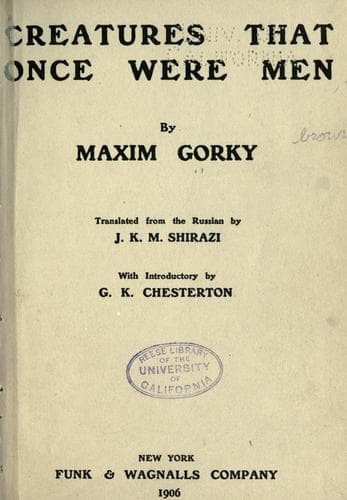
Fiction; Short stories, Russian -- Translations into English
In order to shorten our road to Kertch we left the coast,
and tramped across the steppes. There was nothing in my
knapsack but a three-pound loaf of barley bread, which we
had bought of a Tartar with our last five-kopeck piece.
Owing to this painful circumstance, when, at last we reached Kertch,
we could hardly move our legs, so seeking therefore work was
out of the question. Shakro's attempts to beg by the way had
proved unsuccessful; everywhere he had received the curt refusal:
"There are so many of you."
This was only too true, for the number of people, who,
during that bitter year, were in want of bread, was appalling.
The famished peasants roamed about the country in groups,
from three to twenty or more together. Some carried babies
in their arms; some had young children dragging by the hand.
The children looked almost transparent, with a bluish skin,
under which flowed, instead of pure blood, some sort of thick
unwholesome fluid. The way their small sharp bones projected from
under the wasted flesh spoke more eloquently than could any words.
The sight of them made one's heart ache, while a constant
intolerable pain seemed to gnaw one's very soul.
These hungry, naked, worn-out children did not even cry. But they
looked about them with sharp eyes that flashed greedily whenever they
saw a garden, or a field, from which the corn had not yet been carried.
Then they would glance sadly at their elders, as if asking "Why was I
brought into this world?"
Sometimes they had a cart driven by a dried-up skeleton
of an old woman, and full of children, whose little heads
peeped out, gazing with mournful eyes in expressive
silence at the new land into which they had been brought.
The rough, bony horse dragged itself along, shaking its head
and its tumbled mane wearily from side to side.
Following the cart, or clustering round it, came the grown-up people,
with heads sunk low on their breasts, and arms hanging helplessly at
their sides. Their dim, vacant eyes had not even the feverish glitter
of hunger, but were full of an indescribable, impressive mournfulness.
Cast out of their homes by misfortune, these processions of peasants moved
silently, slowly, stealthily through the strange land, as if afraid that
their presence might disturb the peace of the more fortunate inhabitants.
Many and many a time we came across these processions, and every time
they reminded me of a funeral without the corpse.
Sometimes, when they overtook us, or when we passed them, they would
timidly and quietly ask us: "Is it much farther to the village?"
And when we answered, they would sigh, and gaze dumbly at us.
My travelling companion hated these irrepressible rivals for charity.
Public-domain text, read in full here on John Shaqi.
Reviews
Reviews
No reviews yet
Be the first to share your thoughts on this work.
Elsewhere in the archive
Join the Discussion
Join the discussion
Sign in to leave a comment or review.
Sign InorCreate an account