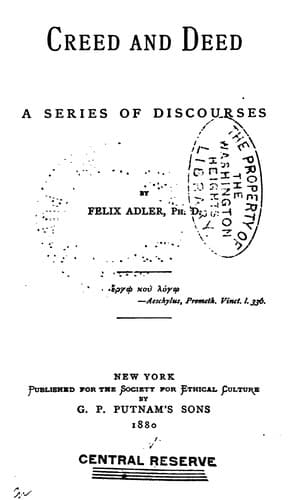
Creed and Deed: A Series of DiscoursesAdler, Felix
Religion
Creed and Deed: A Series of Discourses
Adler, Felix
Ethical culture movement; Ethics; Religion
permit us to enter.* The date of the composition of Deuteronomy is thus
referred to the closing decades of the seventh century B. C.**
* E. G., the rebellion of Korah is unknown to the author of
Deuteronomy.
** The language of Deuteronomy attests its late origin.
Sixty-six phrases of Deuteronomy recur in the writings of
Jeremiah. Vide Zunz, Zeitschrift der Deutschen
Morgenlandischen Gesellschaft, xxviii., p. 670.
The princes who succeeded Josiah fell back into the old course, and
quite undid the work which had begun with such fair promise. Indeed,
little permanent good was to be hoped for in so disordered a condition
of political affairs, and from the degenerate rulers who then swayed
the helm of state. The fortunes of the kingdom of Judah were swiftly
declining, and not fully a quarter of a century after the pious Josiah
had breathed his last, Nebuchadnezzar burned the Temple of Jerusalem,
and carried its inhabitants captive to Babylon.
Heretofore, with but a brief, brilliant interlude, idolatry had been
the court religion of Judah. Early training, long usage, the example of
revered ancestors, had endeared its forms and symbols to the affections
of the people. Resistance to the innovating prophets was natural; men
being then, as ever, loath to abandon the sacred usages which had come
down to them from the distant generations of the past. But, in the long
years of the captivity, a profound change came over the spirit of
the Hebrew people; "by Babel's streams they sat and wept;" by Babel's
streams they recalled the memories of their native land, that land which
they had lost. It was then that the voices of Jehovah's messengers,
which had so earnestly warned them of the approaching doom, recurred to
their startled recollection. They remembered the message; they beheld
its fulfillment; the testimony of the prophets had been confirmed by
events; the one God to whom they testified had revealed his omnipotence
in history; and with ready assent the exiles promised allegiance to his
commandments in the future. The love of country, the dread of further
chastisement, the dear hope of restoration, combined to win them to
the purer worship of their God, and, in the crucible of Babylon, the
national religion was purged of the last dregs of heathendom.
Public-domain text, read in full here on John Shaqi.
Reviews
Reviews
No reviews yet
Be the first to share your thoughts on this work.
Elsewhere in the archive