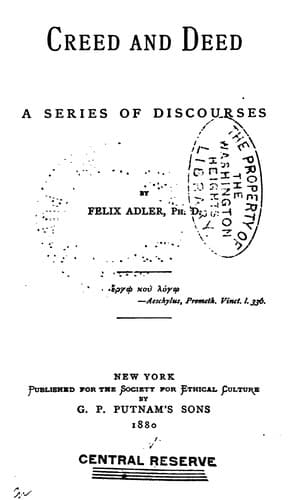
Creed and Deed: A Series of DiscoursesAdler, Felix
Religion
Creed and Deed: A Series of Discourses
Adler, Felix
Ethical culture movement; Ethics; Religion
With the permission of Cyrus, the Jews returned to Palestine and the
Temple at Jerusalem was rebuilt. The question now arose in what
forms the ceremonial of the new sanctuary should be conducted. The
time-honored festivals, the solemn and joyful convocations, the
sacrifices and purifications of the olden time, were all more or
less infected with the taint of paganism. Prophecy would have none of
them--prophecy, free child of genius, contemned sacrifice, denounced the
priesthood, even the temple and its ritual;* proclaimed humbleness and
loving-kindness as the true service in which Jehovah takes delight.
There was formalism on the one hand, idealism on the other. As is
usual in such cases, when the time had arrived for turning theory into
practice, it was found necessary to effect a compromise.
* Jeremiah vii. 4; Isaiah lxvi. 1; Micah vi. 6.
As Christianity in later days adopted the yule-tree into its system, and
lit the lamps of the heathen festival of the 25th of December in honor
of the nativity of its founder, so the leaders of the Jews, in the fifth
century before our era, adopted the feasts and usages of an ancient
Nature-worship, breathed into them a new spirit informed them with a
loftier meaning, and made them tokens, symbols of the eternal God. The
old foes were thus reconciled; priesthood and prophecy joined hands, and
were thenceforth united. As an offspring of this union, we behold a new
code of laws and prescriptions, whose marked and inharmonious features
at once betray the dual nature of its progenitors. "A rough preliminary
draft, as it were," of this code, is preserved in the book of Ezekiel,
composed probably about the middle of the fifth century. In its finished
and final shape, it forms the bulk of a still later work--of Leviticus,
namely the third of the books of the Pentateuch: of all the discoveries
of criticism none more noteworthy, none we are permitted to consider
more assured. What lends additional certainty to the result is the
circumstance that it was reached independently by two of the most
esteemed scholars of our day, the one a Professor of Theology in the
University of Leyden,* the other a veteran of thought, whose brow is
wreathed by the ripe honors of more than fourscore years.** Let us
briefly advert to the line of argument by which this astonishing
conclusion was reached:
* Prof. A. Kuenen.
** The venerable Dr. Zunz, of Berlin.
Public-domain text, read in full here on John Shaqi.
Reviews
Reviews
No reviews yet
Be the first to share your thoughts on this work.
Elsewhere in the archive
Join the Discussion
Join the discussion
Sign in to leave a comment or review.
Sign InorCreate an account