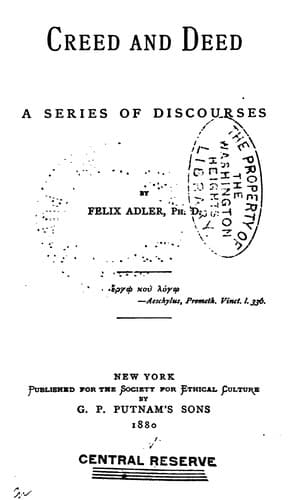
Creed and Deed: A Series of DiscoursesAdler, Felix
Religion
Creed and Deed: A Series of Discourses
Adler, Felix
Ethical culture movement; Ethics; Religion
the fear of taking the name of the Lord in vain induced men to avoid,
if possible, mentioning it at all. We find ha Shem in the above sense in
Lev. xxiv. 11. authorship of Moses attributed to the Levitical code is
symbolical. The name of Moses is utterly unknown to the elder prophets.
* To mention only a single instance, ha Shem (meaning the
name, i. e. the ineffable name of God) was not employed
until very late.
In all their manifold writings it does not occur a single time, though
they make frequent reference to the past. There can now be little doubt
that the composition of the bulk of Leviticus, and of considerable
portions of the books of Numbers, Exodus, and even parts of Genesis,
belongs to the epoch of the second Temple, and that the date of these
writings may be approximately fixed at about one thousand years after
the time of Moses. As to the story of Israel's desert wanderings, it
rests upon ancient traditions whose character it is not our present
business to investigate. It was successively worked up in various
schools of priests and prophets, and this accounts for the host of
discrepancies it contains, some of which have been noticed in the
beginning of this essay. It was finally amplified by the inventive
genius of the second-Temple priesthood, who succeeded in heightening the
sanctity of their own institutions by tracing them back to a revered,
heroic person, who had lived in the dim days of remote antiquity.
In the preceding pages we have indicated the more important phases of
that conflict which ended in the establishment of monotheism, a conflict
whose traces, though sometimes barely legible, are still preserved
in our records. We saw in the first instance that the Mosaic age is
shrouded in uncertainty. We pointed out that pure monotheism was unknown
in the time of the early kings. We briefly referred to the rise of
monotheism. Finally, we endeavored to show how the prophetic idea had
been successively expressed in various codes, each corresponding to a
certain stage in the great process of evolution. From what we have said,
it follows that the prophetic ideal of religion is the root and core
of all that is valuable in the Hebrew Bible. The laws, rites, and
observances, in which it found a temporary and changeful expression,
may lose their vitality; it will always continue to exert its high
influence. It was not the work of one man, nor of a single age, but was
reached in the long course of generations on generations, evolved amid
error and vice, slowly, and against all the odds of time. It has been
said that the Bible is opposed to the theory of evolution. The Bible
itself is a prominent example of evolution in history. It is not
homogeneous in all its parts. There are portions filled with tales of
human error and fallibility. These are the incipient stages of an early
age--the dark and dread beginnings. There are others thrilling with
noblest emotion, freighted with eternal truths, breathing celestial
music.
Public-domain text, read in full here on John Shaqi.
Reviews
Reviews
No reviews yet
Be the first to share your thoughts on this work.
Elsewhere in the archive
Join the Discussion
Join the discussion
Sign in to leave a comment or review.
Sign InorCreate an account