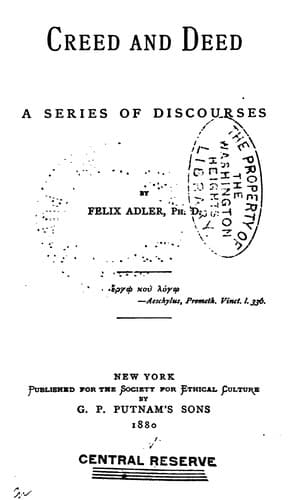
Creed and Deed: A Series of DiscoursesAdler, Felix
Religion
Creed and Deed: A Series of Discourses
Adler, Felix
Ethical culture movement; Ethics; Religion
These are the triumph and the fruition of a later day. It is
thus by discriminating between what is essentially excellent and what
is comparatively valueless that we shall best reconcile the discordant
claims of reason and of faith. The Bible was never designed to convey
scientific information, nor was it intended to serve as a text-book of
history. In its ethical teachings lies its true significance. On them it
may fairly rest its claims to the immortal reverence of mankind.
There was a time in the olden days of Greece when it was demanded that
the poems of Homer should be removed from the schools, lest the minds of
the young might be poisoned by the weeds of superstitious belief. Plato,
the poet-philosopher, it was who urged this demand. That time is past.
The tales of the gods and heroes have long since ceased to entice our
credulity. The story of Achilles's wrath and the wanderings of the sage
Ulysses are not believed as history, but the beauty and freshness and
the golden poetry of the Homeric epic have a reality all their own, and
are a delight and a glory now, as they have ever been before. The Bible
also is a classical book. It is the classical book of noble ethical
sentiment. In it the mortal fear, the overflowing hope, the quivering
longings of the human soul toward the better and the best, have found
their first, their freshest, their fittest utterance. In this respect it
can never be superseded.
To Greek philosophy we owe the evolution of the logical categories; to
Hebrew prophecy, the pure canon of moral principle and action. That
this result was the outcome of a long process of suffering and struggle
cannot diminish its value in our estimation. When we compare the
degrading offices of the Hebrew religion in the days of the judges with
the lofty aspirations of the second Isaiah, when we remember the utter
abyss of moral abasement from which the nobler spirits of the Hebrews
rose to the free heights of prophecy, our confidence in the divine
possibilities of the human soul is reinvigorated, our emulation is
kindled, and from the great things already accomplished we gather the
cheering promise of the greater things that are yet to come. It is in
this moral incentive that the practical value of the evolutionary theory
chiefly lies.*
* Most aptly has this thought been expressed in the lines
with which Goethe welcomed the appearance of F. A. Wolfs
"Prolegomena."
"Erst die Gesundheit des Mannes, der, endhch vom Namen
Homeros Kuhn uns befreiend, uns auch flihrt in die vollere
Bahn. Denn wer wagte mit Gettern den Kampf? und wer mit dem
Einen?--Doch Homeride zu seyn, auch nur als letzter, ist
schon."
The Elegy of Hermann und Dorothea
II. REFORMED JUDAISM.
Public-domain text, read in full here on John Shaqi.
Reviews
Reviews
No reviews yet
Be the first to share your thoughts on this work.
Elsewhere in the archive
Join the Discussion
Join the discussion
Sign in to leave a comment or review.
Sign InorCreate an account