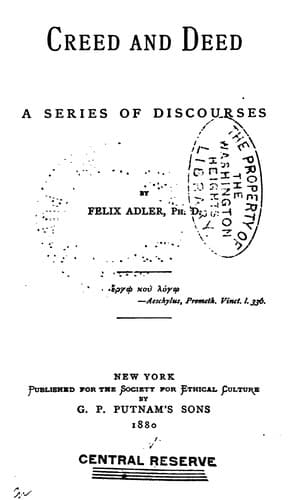
Creed and Deed: A Series of DiscoursesAdler, Felix
Religion
Creed and Deed: A Series of Discourses
Adler, Felix
Ethical culture movement; Ethics; Religion
"Let thy house be the resort of the wise, and let the dust of their feet
cover thee, and drink in thirstily their words." Joshua ben Perachia
says: "Get thee an instructor, gain a companion [for thy studies], and
judge all men upon the presumption of their innocence." Hillel says:
"Who gains not in knowledge loses.... Say not, 'When I am at leisure
I will study'; 't is likely thou wilt never be at leisure.... He who
increases flesh increases corruption; he who increases worldly goods
increases care; he who increases servants increases theft; but he who
increases in the knowledge of the Law increases life." Jochanan ben
Sakkai says: "If thou art wise in the knowledge of the Law, take not
credit to thyself, for to this end wast thou created."
* For a concise but comprehensive account of the origin of
the Talmud, vide the art. Talmud in Johnson's Encyclopaedia.
** Collected in the Tract Aboth (Fathers).
After the destruction of the Temple by Titus, academies sacred to the
study of the Law were erected in different cities of Palestine, and
similar institutions flourished on the banks of the Euphrates. In the
eleventh century the chief seats of Jewish learning were transplanted
to the West; and since that time the European Jews have excelled their
brethren of the East in all the elements of mental culture. In the
course of their manifold wanderings the Jews carried their libraries
everywhere with them. Wherever a synagogue arose, a school for young
children and a high school for youths were connected with it. In the
dark night of the ghetto the flame of knowledge was never quenched.
While the nations of Europe were still sunk in barbarism the Jews
zealously devoted themselves to the pursuit of medicine, mathematics,
and dialectics, and the love of learning became an hereditary quality
in their midst. The efforts of many generations have contributed to keep
their intellectual faculties bright; and, unlike most oppressed races,
they have emerged from a long epoch of systematic persecution well
fitted to attack the problems of the present with fresh interest and
undiminished capacity.
THE DEMOCRATIC ORGANIZATION OF THE SYNAGOGUE.
Public-domain text, read in full here on John Shaqi.
Reviews
Reviews
No reviews yet
Be the first to share your thoughts on this work.
Elsewhere in the archive
Join the Discussion
Join the discussion
Sign in to leave a comment or review.
Sign InorCreate an account