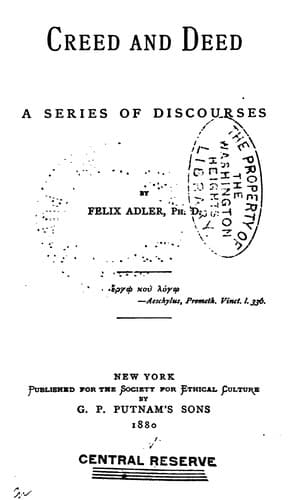
Creed and Deed: A Series of DiscoursesAdler, Felix
Religion
Creed and Deed: A Series of Discourses
Adler, Felix
Ethical culture movement; Ethics; Religion
The spirit of monotheism is essentially democratic both in politics
and religion. There is to be but one king, and he the spiritual Lord
in heaven. All the people are equal before him. When the Hebrews
clamorously demanded a king the prophet charged them with treason
against their proper ruler. The prophet and priest were hostile powers;
and their antagonism was clearly felt, and sometimes energetically
expressed. The Lord takes no delight in the slaughter of animals. The
bloody sacrifices are an offence to Him. What He requires is purity of
heart, righteous judgment, and care for the widow and the fatherless.
The idea of priestly mediation--of mediation in any shape--was repugnant
to the Jews. "The whole people are priests," it was said. When the
sanctuary at Jerusalem had been laid in ashes, anything resembling a
hierarchical caste was no longer tolerated among them. The Law and
the Science of the Law were open to all; and each one was expected,
according to the measure of his capacity, to draw directly from the
fountain-head of faith. The autonomy of the congregations was strictly
guarded. Entire uniformity in the ritual was never achieved.* The public
lector of prayers was called "the delegate of the congregation." The
Rabbies (the word means Masters, in the sense of teachers) were men
distinguished for superior erudition and the blamelessness of their
lives, and these qualities formed their only title to distinction.**
Their duties differed radically from those of the Catholic priest or the
Protestant clergyman. They never took upon themselves the care of souls.
Their office was to instruct the young, and in general to regulate the
practice of religion according to the principles and precedents laid
down in the sacred traditions of their people. The several congregations
were independent of each other. There were no general synods or
councils, no graded hierarchy culminating in a spiritual head, no
oligarchy of ministers and elders; but rather a federation of small
communities, each being a sovereign unit, and connected with the others
solely by the ties of a common faith, common sympathies, and common
sufferings. Any ten men were competent to form themselves into a
congregation, and to discharge all the duties of religion. The fact that
this was so proved of the utmost consequence in preserving the integrity
of Judaism. The Jews were parcelled out over the whole earth. The body
of the people was again and again divided. But in every case the
barest handful that remained sufficed to become the nucleus of new
organizations. Had the system of Judaism required any one central organ,
a blow aimed against this would doubtless have proved fatal to the
whole. But by the wise provisions of the federative system the vital
power seems to have been equally disseminated over the entire community.
Like the worm that is trodden under foot, to which Israel so often
likens itself in the Hebrew prayers, the divided members lived a new
Public-domain text, read in full here on John Shaqi.
Reviews
Reviews
No reviews yet
Be the first to share your thoughts on this work.
Elsewhere in the archive
Join the Discussion
Join the discussion
Sign in to leave a comment or review.
Sign InorCreate an account