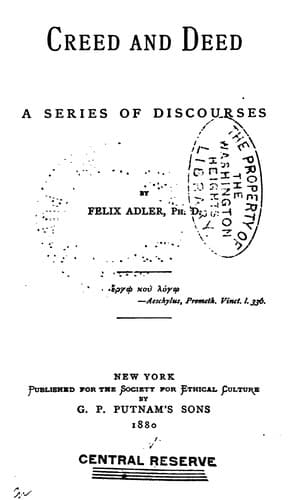
Creed and Deed: A Series of DiscoursesAdler, Felix
Religion
Creed and Deed: A Series of Discourses
Adler, Felix
Ethical culture movement; Ethics; Religion
By the crucifixion of Jesus the Jews had forfeited for themselves and
their posterity the right to exist in Christian states. They lived on
sufferance merely. In the feudal system there was no room for them. They
were aliens, were regarded as the property of the Emperor, and he was
free to deal with them as suited his convenience. Hence the name _servi
camera_--servants of the imperial chamber--was applied to them. They
could be sold, purchased, given away at pleasure. Charles IV. presented
"the persons and property of his Jews" to the city of Worms. In a
schedule of toll-dues dating from the year 1398 we read: "a horse pays
two shillings, a Jew six shillings, an ox two heller."** They were
compelled to wear a badge of shame upon their garments;*** were confined
to narrow and filthy quarters,---_ghetto, juderia_,--debarred from all
honorable employments. The schools and universities were closed against
them. The guilds shut them out from the various trades. To gain the
means of subsistence nothing remained for them but to engage in the
petty traffic of the peddler or the disreputable business of the
money-lender. They had absolutely no choice in the matter. The laws of
Moses certainly discountenance the lending of money at interest. The
authorities of the Talmud severely condemn the practice of usury, and
refuse to admit the testimony of usurers in courts of law.****
* Cassel, art. Juden, p. 83, in Ersch und Gruber; vide also
p. 85, "ad perpetuam Judaici sceleris ultionem eisdem
Judaeis induxerit perpetuam servitutem."
** Ibid, p. 91
*** The _signum circulate_ was borrowed from Islam. It has
been ingeniously conjectured that the circular form was
selected in contradistinction to the sign of the crescent.
Ibid, p. 75.
**** Mishna Sanhedrin, III. 3.
But all scruples on the part of the Jews had now to be set aside. Gold
they must have, and in abundance. It was the only means of buying their
peace. The taxes levied by the imperial chamber were enormous.* The
cities, the baronial lords, in whose territory they took refuge,
constantly imposed new burdens as the price of toleration. The Jews
have often been held up to contempt for their avarice and rapacity.
The reproach is unjust. It reminds one of the ancient Philistines, who,
having shorn the Hebrew of his strength and blinded him, called him with
jeers from his prison-house to exhibit him to the popular gaze and to
make sport of his infirmity.
Public-domain text, read in full here on John Shaqi.
Reviews
Reviews
No reviews yet
Be the first to share your thoughts on this work.
Elsewhere in the archive
Join the Discussion
Join the discussion
Sign in to leave a comment or review.
Sign InorCreate an account