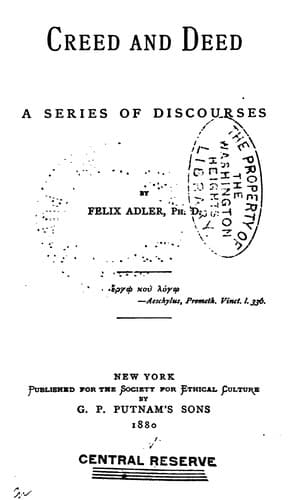
Creed and Deed: A Series of DiscoursesAdler, Felix
Religion
Creed and Deed: A Series of Discourses
Adler, Felix
Ethical culture movement; Ethics; Religion
Under these circumstances the conservatism of the Jews in matters of
religion can no longer astonish us. Rejected by the world, they lived
in a world of their own. They had inherited from their ancestors an
extended code of ceremonial observances, dietary laws, and minute and
manifold directions for the conduct of life. In these they beheld the
bulwark of their religion, the common bond that united the scattered
members of their race. The Jew of Persia or Palestine could come among
his German brethren, and hear the same prayers expressed in the same
language, and recognize the same customs as were current among his
co-religionists in the East. The passwords of the faith were everywhere
understood. To preserve complete unanimity with respect to
religious usage was a measure dictated by the commanding instinct of
self-preservation. The Jews of all countries were furthermore united by
the common yearnings with which they looked back to the past, and their
common hope of ultimate restoration to the heritage of the promised
land.**
* A general tax paid in recognition of the Emperor's
protection; the Temple tax claimed by the Holy Roman
Emperor in his capacity as the successor of Vespasian; the
so-called _aurum coronarium_, or coronation tax, by virtue
of which every new emperor, upon his accession to the
throne, could confiscate the third part of the property of
the Jews. Besides these, extraordinary levies were
frequent.
** On the eve of the 9th of the fifth month it was customary
at Jerusalem to announce the number of years that had
elapsed since the fall of the Temple. Zunz, Die Ritus, p.
84.
Public-domain text, read in full here on John Shaqi.
Reviews
Reviews
No reviews yet
Be the first to share your thoughts on this work.
Elsewhere in the archive
Join the Discussion
Join the discussion
Sign in to leave a comment or review.
Sign InorCreate an account