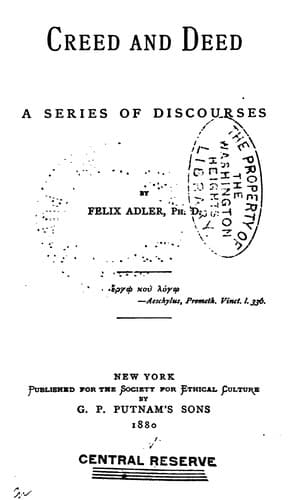
Creed and Deed: A Series of DiscoursesAdler, Felix
Religion
Creed and Deed: A Series of Discourses
Adler, Felix
Ethical culture movement; Ethics; Religion
On the 28th September, 1791, the National Convention decreed
the equality of the Israelites of France with their Christian
fellow-citizens. The waves of the Revolution, however, overflowed
the borders of France, and the agitation they caused was quickly
communicated to all Germany. Wherever the armies of the Republic
penetrated, the gates of the ghettos were thrown open, and in the name
of Fraternity, Liberty and Equality were announced to their inhabitants.
When Napoleonic misrule at last exasperated Germany into resistance, the
seeds which French influence had sown had already taken firm root in the
German soil. On the 11th March, 1812, Frederick William III. issued his
famous edict, removing the main disabilities from which the Jews of his
dominions had suffered, granting them the rights and imposing upon them
the honorable duties of citizenship. They were no longer to be classed
as foreigners. The state claimed them as its children, and exacted of
them the same sacrifices as all its sons were called upon to bring in
the troublous times that soon followed. With what eager alacrity the
Jews responded to the king's call the records of the German wars for
independence amply testify. On the battlefields of Leipzig and Waterloo
they stood side by side with their Christian brethren. Many sons and
fathers of Jewish households yielded their lives in the country's
defence. In the blood of the fallen the new covenant of equal justice
was sealed for all time to come. However prejudice might still dog their
footsteps, however shamefully the government might violate its solemn
pledges to the Jewish soldiers on their return from the wars, the Jews
of Germany had now gained what they could no more lose. They felt that
the land for which they had adventured their all, in whose behalf they
had lost so much, was indeed their fatherland. For the first time, after
many, many centuries, the fugitives had gained a home, a country. They
awoke as from a long sleep. They found the world greatly changed around
them; vast problems engaging the attention of thinkers, science and
philosophy everywhere shedding new light upon the path of mankind. They
were eager to approve themselves worthy and loyal citizens, eager to
join in the general work of progress. They dwelt no more with anxious
preference on the past. The present and the future demanded their
exertions, and the motives that had so long compelled their exclusion
from the fellowship of the Gentiles were gradually disappearing. As
their religion was mainly retrospective in character and exclusive in
tendency, great changes were needed to bring it into harmony with the
altered condition of affairs. These changes were accordingly attempted,
and their history is the history of Jewish Reform.
III. REFORMED JUDAISM.
Public-domain text, read in full here on John Shaqi.
Reviews
Reviews
No reviews yet
Be the first to share your thoughts on this work.
Elsewhere in the archive
Join the Discussion
Join the discussion
Sign in to leave a comment or review.
Sign InorCreate an account