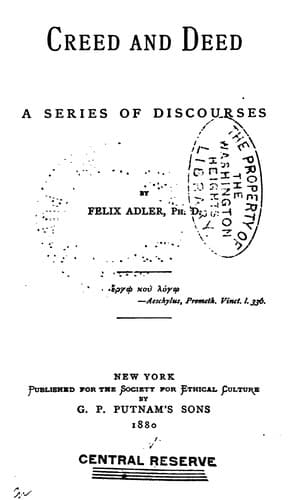
Creed and Deed: A Series of DiscoursesAdler, Felix
Religion
Creed and Deed: A Series of Discourses
Adler, Felix
Ethical culture movement; Ethics; Religion
However prolonged their abode in the land of the stranger might be, they
never regarded it otherwise than in the light of a temporary sojourn,
and Palestine remained their true fatherland, "If I forget thee,
Jerusalem, wither my right hand," was sung as plaintively on the banks
of the Danube and the Rhine as it had resounded of old by Babel's
streams. The Jewish people walked through history as in a dream, their
eyes fixed on Zion's vanished glories. Empires fell; wars devastated the
earth; new manners, new modes of life, arose around them. What was all
this toil and turmoil of the nations to them! They were not admitted
to the fellowship of mankind, they preserved their iron stability, they
alone remained changeless. So long as the world maintained its hostile
attitude toward them, there was little likelihood that they would
abandon their time-honored traditions. But toward the close of the
last century the first tokens of political, social, and spiritual
regeneration began to appear among the despondent people of the Hebrews.
The spirit of the Reformation, which had slumbered so long, awoke to
new vitality. The voice of love rebuked the selfishness of creeds;
Philosophy in the person of Kant emphasized the duties of man to man;
Poetry sent its warm breath through the German land, and with its sweet
strains instilled broad, humanitarian doctrine into the hearts of men.
Lessing celebrated the virtues of his friend, Moses Mendelssohn, in
"Nathan the Wise," and in the parable of the rings showed how the
true religion is to be sought and found. The Royal Academy at Berlin
nominated the same Mendelssohn for membership in its body. Jewish
scholars were received with distinction in the Austrian and Prussian
capitals. Eminent statesmen and writers began to exert themselves
to remove the foul blot that had so long stained the conduct of the
Christian states in their dealings with the Jews. In France the
great Revolution was rapidly sweeping away the accumulated wrongs of
centuries. When the emancipation of the Jews came up for discussion
in the Convention, the ablest speakers rose in their behalf. The Abbe
Gregoire exclaimed: "A new century is about to open. May its portals be
wreathed with the palm of humanity!" Mirabeau lent his mighty eloquence
to their cause. "I will not speak of tolerance," he said; "the freedom
of conscience is a right so sacred that even the name of tolerance
involves a species of tyranny."*
*Vide the account of the debates in the official Moniteur.
Public-domain text, read in full here on John Shaqi.
Reviews
Reviews
No reviews yet
Be the first to share your thoughts on this work.
Elsewhere in the archive
Join the Discussion
Join the discussion
Sign in to leave a comment or review.
Sign InorCreate an account