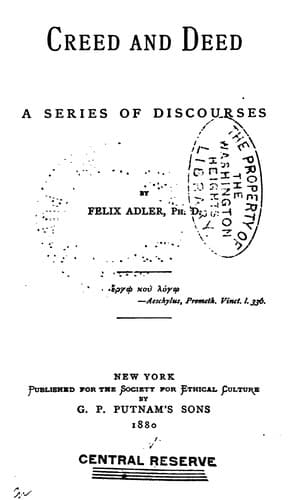
Creed and Deed: A Series of DiscoursesAdler, Felix
Religion
Creed and Deed: A Series of Discourses
Adler, Felix
Ethical culture movement; Ethics; Religion
Again Mendelssohn was the first to break through the social restraints
that obstructed the intercourse of Jews and Christians, and thus
triumphed over a form of prejudice which is commonly the last to yield.
His fame as a writer greatly assisted him in this respect. The grace
and freshness of his style, the apparent ease with which he divested the
stern problems of philosophy of their harsher aspects, had won him many
and sincere admirers. His "Phaedon" was eagerly read by thousands, whom
the writings of Leibnitz and Kant had repelled. On the afternoon of the
Jewish Sabbath he was accustomed to assemble many of the choice spirits
of the Prussian capital, among whom we may mention Lessing, Nikolai,
and Gleim, in his home. The conversation turned upon the gravest
and loftiest topics that can occupy the human soul. The host himself
skilfully guided the stream of discussion, and the waves of thought
flowed easily along in that placid, restful motion which is adapted to
speculative themes. The spirit that of old had hallowed the shades of
Academe presided over these gatherings. Mendelssohn emulated the plastic
idealism of Plato and the divine hilarity of Socrates. The singular
modesty, the truthfulness and quiet dignity that adorned his character
were reflected upon the people from whom he had sprung, and produced a
salutary change in their favor in the sentiments of the better classes.
But it is as the author of a profound revolution in the Jewish religion,
that Mendelssohn attracts our especial interest. Not, indeed, that he
himself ever assumed the character of a religious reformer. He was, on
the contrary, sincerely devoted to the orthodox form of Judaism, and
even had a change appeared to him feasible or desirable, he would in all
probability have declined the responsibility of publicly advocating it.
His was the contemplative spirit which instinctively shrinks from the
rude contact of reality. He had neither the aggressive temper nor the
bold self-confidence that stamp the leader of parties. And yet,
without intending it, he gave the first impulse to Jewish Reform, whose
subsequent progress, could he have foreseen it, he would assuredly have
been the first to deprecate.
THE BIBLE.
Public-domain text, read in full here on John Shaqi.
Reviews
Reviews
No reviews yet
Be the first to share your thoughts on this work.
Elsewhere in the archive
Join the Discussion
Join the discussion
Sign in to leave a comment or review.
Sign InorCreate an account