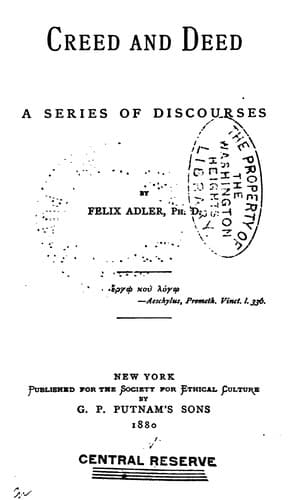
Creed and Deed: A Series of DiscoursesAdler, Felix
Religion
Creed and Deed: A Series of Discourses
Adler, Felix
Ethical culture movement; Ethics; Religion
The condition of the Jews at the close of the last century was in many
respects unlike that of any other race that has ever been led from a
state of subjection to one of acknowledged equality. Long oppression
had not, on the whole, either blunted their intellects or debased their
morals. If they were ignorant in modern science and literature, they
were deeply versed in their own ancient literature, and this species
of learning was not the privilege of a single class, but the common
property of the whole people. What they lacked was system. In the
rambling debates of the Talmud the true principles of logical sequence
are but too often slighted, and the student is encouraged to value the
subtle play of dialectics on its own account, without regard to any
ultimate gain in positive and useful knowledge. Impatience of orderly
arrangement being allowed to develop into a habit, became contagious. It
impressed itself equally on the thought, the manners, the language*
of the Jews, and contributed not a little to alienate from them the
sympathies of the refined. Such, however, was the preponderating
influence of the Talmud that it not only engrossed the attention of the
Jewish youth to the exclusion of secular knowledge, but even perverted
the exegesis of the Bible and caused the study of Scripture to be
comparatively neglected.
* The German Jews spoke a mixed dialect of German and
Hebrew, which has been likened to the so-called Pennsylvania
Dutch.
To weaken the controlling influence of the Talmud became the first
needful measure of Reform, and to accomplish this it was necessary to
give back to the Bible its proper place in the education of the young.
It was an event, therefore, of no mean significance when Mendelssohn,
in conjunction with a few friends, determined to prepare a German
translation of the Pentateuch, and thus, by presenting the teachings of
Scripture in the garb of a modern tongue, to render their true meaning
apparent to every reflecting mind. The work was finished in 1783.
It holds a like relation to the Jewish Reform movement that Luther's
translation held to the great Protestant movement of the sixteenth
century. It was greeted with a storm of abuse upon its appearance, and
was loudly execrated by the orthodox as the beginning of larger and
far-reaching innovations. Its author might sincerely protest his entire
innocency of the radical designs imputed to him, but subsequent events
have proved the keener insight of his opponents. The influence of the
new translation was twofold. In the first place it facilitated a more
correct understanding of the doctrine, the literature and language of
Scripture; secondly,--and this is worthy of special remark,--it served
the purpose of a text-book of the German for the great mass of the Jews,
who were at that time unable to read a book written in the vernacular,
and thus became the means of opening to them the treasure-house of
modern thought.*
Public-domain text, read in full here on John Shaqi.
Reviews
Reviews
No reviews yet
Be the first to share your thoughts on this work.
Elsewhere in the archive
Join the Discussion
Join the discussion
Sign in to leave a comment or review.
Sign InorCreate an account