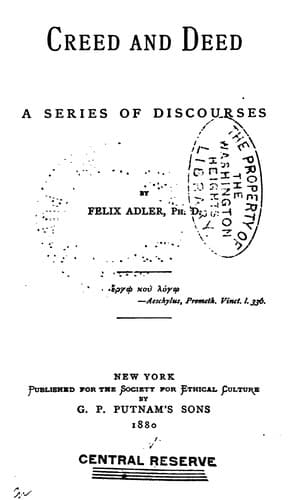
Creed and Deed: A Series of DiscoursesAdler, Felix
Religion
Creed and Deed: A Series of Discourses
Adler, Felix
Ethical culture movement; Ethics; Religion
* The German of Mendelssohn's translation was written
in Hebrew letters.
In the very year in which Mendelssohn's work appeared we notice among
the younger generation a general revival of interest in the Hebrew,
the mother-tongue of their race. Two students of the University of
Konigsberg began the issue of a periodical devoted to the culture of
the Hebrew, which was widely read and attracted great attention. Poems,
original essays, Hebrew versions of modern writings, appeared in its
columns; the style of the Prophets and of the Psalmists was emulated,
the works of the ancient masters of the language served as models, and
in the aspect of the noble forms employed in the diction of the biblical
authors the aesthetic sense of the modern Jews revived. We are inclined
to doubt whether the Hebrew Bible, considered merely with a view to
its aesthetic value, is even yet fully appreciated. The extravagance
of religious credulity and the violent extreme of scepticism have alike
tended to obscure its proper merits. The one accustomed to behold in the
"holy book" a message from the Creator to his creatures shrinks, as a
rule, from applying to the work of a Divine author the critical standard
of human composition. The sceptics on the other hand, impatient of the
exorbitant claims which are urged for the sacred writings of the Jews,
and resenting the sway which they still exercise over the human reason,
are hardly in a proper frame of mind to estimate justly its intrinsic
and imperishable excellences. And yet, setting aside all questions of
the supernatural origin of the Bible, and regarding only the style in
which its thoughts are conveyed, how incomparably valuable does it still
remain! It would be difficult to calculate the extent to which many of
our standard authors are indebted for the grandest passages of their
works to their early familiarity with the biblical style. Those who
are able to read the text in the original become aware of even subtler
beauties that escape in the process of translation. Purity of diction,
power of striking antithesis, simple and yet sublime imagery, a
marvellous facility in the expression of complex states of feeling, and
those the deepest of which the human soul is capable, are but a few
of the obvious features that distinguish the golden age of Hebrew
literature. Never perhaps has the symbolism of nature been used with
such supreme effect to express the unspeakable emotions that are deep
down in the heart of man. Such music as that which swells through the
pages of Isaiah's prophecies cannot be forgotten; such ringing, rhythmic
periods, in which the eloquence of conviction bursts forth into the
rounded fulness of perfect oratory, can never fail to touch and to
inspire. We know of no nobler pattern on which the modern orator could
mould his style. And thus, too, the exquisite poetry of the Song of
Songs, the idyl of the Book of Ruth, the weird pathos of Jeremiah's
Public-domain text, read in full here on John Shaqi.
Reviews
Reviews
No reviews yet
Be the first to share your thoughts on this work.
Elsewhere in the archive
Join the Discussion
Join the discussion
Sign in to leave a comment or review.
Sign InorCreate an account