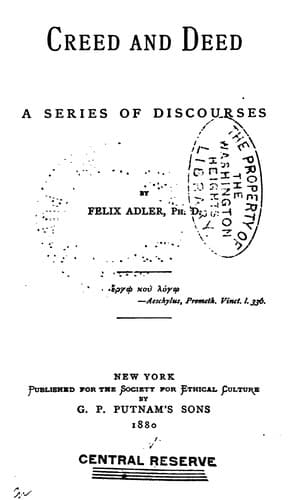
Creed and Deed: A Series of DiscoursesAdler, Felix
Religion
Creed and Deed: A Series of Discourses
Adler, Felix
Ethical culture movement; Ethics; Religion
The manner in which these conclusions were reached may be described
as follows. At first an attempt was made to found each new measure of
Reform on the authority of the Talmud. The Talmud was attacked with
its own weapons. The fallacy of such a method becoming apparent, the
authority of the Talmud was entirely set aside. A return to the Bible
was next in order. But even the laws of the Bible proved to be no longer
capable of fulfilment in their totality. A distinction was therefore
drawn between the letter and the spirit of the Bible. The letter is
man's handiwork, the spirit alone ought to be regarded as the Divine
rule of faith. The "spirit of the Bible" is the essence of Judaism,
which cannot change. In the process of evolution it constantly assumes
new forms, but remains substantially the same. Nor could any motives of
expediency, nor could even the ardent desire of political emancipation
have induced the Reformers to pursue the course they did, had they for
one moment believed it contrary to the substantial teachings of
the Bible. The spirit of the Bible is expressed in two fundamental
propositions: the existence of one God, the author and governor of the
universe; and the Messianic mission of the people of Israel. The
former is no longer the exclusive property of Judaism, the latter is
distinctively its own; both together express the simple creed of the
Reformers.
PROSPECTS.
If now we cast a glance upon the present aspect of Reformed Judaism we
are confronted by a state of affairs that by no means corresponds to
the great anticipations which were connected with the movement in its
earlier stages. The ancient institutions have been cleared away,--that
was unavoidable; they had long been tottering to their ruin,--but
an adequate substitute for what was taken has not been provided. The
leaders have penetrated to the foundations of their religion, but
upon these bare foundations they have erected what is at best a mere
temporary structure incapable of affording them permanent shelter and
protection. The temper of the Reform school has been critical.
Its members were admirably fitted to analyze and to dissect; their
scholarship is unquestionably great; the stainless purity of their lives
has elevated the character of their people and entitled them to sincere
respect But they lacked the constructive genius needed for the creation
of new institutions. In the year 1822 Wholwill declared that "the Jews
must raise themselves and their principle to the level of science.
Science is the one bond that alone can unite the whole human race." The
emphasis thus placed on science has continued to distinguish the Reform
movement down to the present day. In the sphere of religion, however, it
is not sufficient to apprehend the abstract truth of ideas with the
help of intellect, but it is necessary to array these ideas in concrete
forms, in order that they may warm the heart and stimulate the will.
Public-domain text, read in full here on John Shaqi.
Reviews
Reviews
No reviews yet
Be the first to share your thoughts on this work.
Elsewhere in the archive
Join the Discussion
Join the discussion
Sign in to leave a comment or review.
Sign InorCreate an account