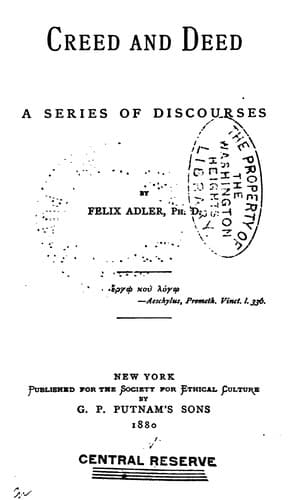
Creed and Deed: A Series of DiscoursesAdler, Felix
Religion
Creed and Deed: A Series of Discourses
Adler, Felix
Ethical culture movement; Ethics; Religion
We hold it erroneous to believe that the age of symbolism is passed. The
province of religion is to bring the human soul into communion with
the Infinite. In the lower religions the conception of the Infinite was
meagre and insufficient and the symbols in use proportionately gross.
At the present day it is the ideal of moral perfection that alone is
capable of exciting our devotion and kindling our enthusiasm. Now it is
true that the material symbolism of the churches and the synagogues, the
venerable, the bread and wine, the scrolls of the Pentateuch tricked
out in fanciful vestments, fail to appeal to the sympathies of many
educated men and women of our time; not, however, because they are
symbols, but because they are inadequate symbols, because of an almost
painful disparity between their earthy origin and the vastness of the
spiritual ideas which they are intended to suggest. There is, on the
other hand, a species of symbolism peculiarly adapted to the needs of
the present generation, and which, if properly understood, might be
employed to incalculable advantage in the interest of a revival of the
religious sentiment. We allude to the symbolism of association.
The tendency to associate the efforts of individuals in corporate action
has never been more markedly displayed than in our own day. So long as
such associations confine themselves to certain finite objects, they are
mere social engines organized with a view to utility and power, and
with such we are not concerned. The characteristic of symbols is their
suggestiveness. They have a meaning in themselves, but they suggest
illimitable meanings beyond their scope. Now a form of organization is
not only conceivable, but has actually been attempted, that fully meets
the requirements of the symbolic character. The Christian Church is
designed to be such an organization. Not only does it propose to unite
its members and to satisfy their spiritual needs during the term of
their sojourn on earth, but it aspires to typify the union of all saints
under the sovereignty of Jesus, and thus to give to the believer a
presentiment of the felicity and perfection of the higher world. In
like manner the Hebrews have been acquainted with the symbolism of
association from a very early period of their history. If they delight
to style themselves the chosen people, the meaning of that phrase, so
often misunderstood, is purely symbolical.
Public-domain text, read in full here on John Shaqi.
Reviews
Reviews
No reviews yet
Be the first to share your thoughts on this work.
Elsewhere in the archive
Join the Discussion
Join the discussion
Sign in to leave a comment or review.
Sign InorCreate an account