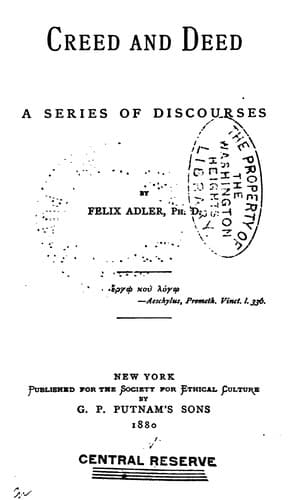
Creed and Deed: A Series of DiscoursesAdler, Felix
Religion
Creed and Deed: A Series of Discourses
Adler, Felix
Ethical culture movement; Ethics; Religion
At the grave also is the office of the priest, When some dear friend has
been taken from us, when the whole earth seems empty for the loss
of one and the pillars of existence seem broken, he shall say to the
grieving heart: Arise, be strong. He shall bid your brooding sorrow
pause. He shall speak of larger duties, which they you mourn have left
you, as their legacy. Larger duties: this is his medicine. You are not
free, you poor and sadly stricken friends to stand aside in idle woe,
but you shall make for the departed a memorial in your lives and assume
their half completed tasks. So the loss, though loss it be, will purify
you, and vim and vigor be found in the consolations of the Ideal. We
trust that we have used the term priest in no narrow restricted sense.
It is not the hierarchies of the past or the present of whom we have
spoken. The priest is not superior to his fellow men, nor has he access
to those transcendental regions which are closed to others. His power
is in this, that he speaks what all feel. And he shall be counted an
acceptable teacher, then only, when the slumbering echoes within you
waken to the music that moves and masters him.
There have been those, whose lives were molded on such a pattern among
the clergy at all times, and it is this circumstance, that has attracted
the reverence of mankind to the priestly office.
Noble men were they whose love burst through the cramping fetters of
their creeds, apostles of liberty, missionaries of humanity.
But there is one other trait necessary to complete the picture. The
priest of the Ideal must have the gift of tongues and kingly words to
utter kingly thoughts. In the philosophy of Alexandria it was held, that
before the world was, the word was, and the word created a universe out
of chaos and the word was divine. With that heaven-born energy must he
be filled, and with a breath of that creative speech must he inspire.
No tawdry eloquence be his, no glittering gift of phrase or fantasy, but
words of the soul's own language, words of the pith and core of truth.
The image of the Ideal priest which I have attempted to draw is itself
an ideal image, nowhere realized, never to be fully attained. But it
is to it that the priests of the new age will strive to come near and
nearer, and that will be their pride and their happiness, if they can
become in this sense friends and helpers of their kind.
Public-domain text, read in full here on John Shaqi.
Reviews
Reviews
No reviews yet
Be the first to share your thoughts on this work.
Elsewhere in the archive
Join the Discussion
Join the discussion
Sign in to leave a comment or review.
Sign InorCreate an account