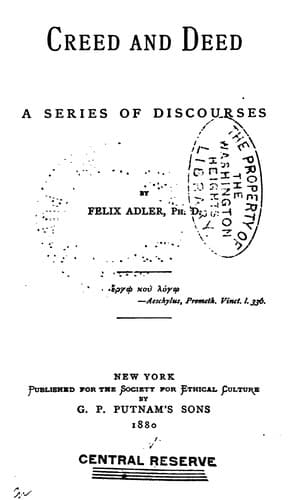
Creed and Deed: A Series of DiscoursesAdler, Felix
Religion
Creed and Deed: A Series of Discourses
Adler, Felix
Ethical culture movement; Ethics; Religion
In the eyes of the dogmatist they are strangers out of a strange land of
thought. If you ask them for their pass word, it is freedom, if you ask
for their creed, it is boundless. The multitude seeking to compress
the infinite within the narrow limits of the senses, must needs have
tangible shapes to lay hands on, names if nothing better. But the Ideal
in the highest is void of form and its name unutterable. We will ascend
on the wings of the morning, we will let ourselves down to the uttermost
depths of the sea, and know it there. But chiefly within ourselves shall
we seek it, in ourselves is its shrine. The time will come when single
men shall no more be needed to do its ministry, when in the brotherhood
and sisterhood of mankind all shall be priests and priestesses one to
another, for all their life shall be a song of praise to the highest,
and their whole being shall be consecrated and glorified in the immortal
service of deathless Ideals.
V. THE FORM OF THE NEW IDEAL
A NEW ORDER.
I AM aware that there exists a deep seated prejudice in the minds of
many of my hearers against what are called the forms of religion. We
have too long experienced their limitations and restraints, not to be
jealous now of our hard won liberties. But let us ask ourselves what
it is that alienates our sympathies from the ritual and ceremonial
observances of the dominant creeds? Is it the forms as such? Is it not
rather the fact that to us they have become dead forms: that they no
longer appeal to our sentiments, that they fail to stir, to invigorate,
to ennoble us? We have not cast them aside lightly. Often have we
entered the house of worship, prepared to be drawn back into the
influence of its once familiar surroundings: we beheld again the great
assembly, we heard the solemn music, we listened to the preacher as he
strove to impress upon a silent multitude, the lessons of the higher
life. But in the prayers we could not join, and the words to which
the music moved we could not sing, and the maxims of the preacher were
couched in language, and enforced with doctrinal arguments that touched
no chord in our hearts. We left disappointed, we had received no help:
if this were religion, we felt ourselves more distant from religion than
ever before.
Public-domain text, read in full here on John Shaqi.
Reviews
Reviews
No reviews yet
Be the first to share your thoughts on this work.
Elsewhere in the archive
Join the Discussion
Join the discussion
Sign in to leave a comment or review.
Sign InorCreate an account