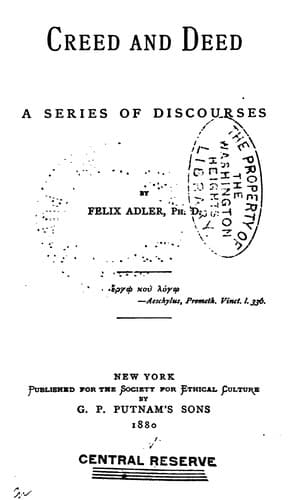
Creed and Deed: A Series of DiscoursesAdler, Felix
Religion
Creed and Deed: A Series of Discourses
Adler, Felix
Ethical culture movement; Ethics; Religion
The "fine phrase," humanity has pregnant meanings. They stand for the
grandest, the sternest realities of the times. Purity, charity and
simplicity, these shall be the watchwords of a new fellowship, which
shall practice the teachings of humanity, that are vain as the empty
wind, if heard only and approved, but not made actual in our deeds.
And yet some will smile incredulously and ask, where are the men and
women prepared to undertake such a task? It is true, we must begin at
the beginning. From earliest childhood the young must be trained on
a nobler method, and in the ethical school lies the main work of
preparation. There every step in the course of development must be
carefully considered, vigilantly watched and wisely directed, to the
one crowning purpose of ripening the young minds and hearts for that
fellowship of love and hope.
A new fellowship, a new order, I say boldly, whose members shall not be
bound by any vows, which shall have no convents, no mysteries, but shall
make itself an exemplar of the virtues it preaches, a form of the ideal.
The perils that attend such organizations are great; we will not attempt
to underrate their gravity, but we believe they can be overcome. The
spirit of co-operation lends mighty momentum to every cause; it depends
upon the cause itself whether the influence exerted shall be for good or
evil. And there has been in history a single order at least of the kind
which I describe: "The brotherhood of the common life," it was called;
an order composed of earnest, studious men, to whom the upheaval of
Europe in the sixteenth century was largely due; a noble brotherhood
that prepared the way for the great Reformation. The Catholic orders are
dedicated to the world to come; the order of the Ideal will be dedicated
to the world of the living: to deepen and broaden the conscience of men
will be its mission.
The propaganda of Liberalism in the past has been weak and barren of
great results. Strong personalities it has brought forth; around these
societies have clustered and fallen asunder when the personal magnet was
withdrawn. What we need is institutions of which persons shall be merely
the exponents; institutions that must be grounded on the needs of the
present, and that shall last by their own vitality, to future ages and
to the increase of future good.
It is the opening of the spring.* After its long winter sleep, the earth
reawakens, and amid the fierce storms of the Equinox nature ushers in
the season of flowers and of summer's golden plenty. It is the day of
Easter. Loudly the bells are pealing and joyous songs celebrate in the
legend of "Christ risen from the grave," the marvel of the Resurrection.
What we cannot credit of an individual, is true of the nations. After
long periods of seeming torpor and death, humanity ever arises anew from
the dust, shakes off its slumbers, and clothes itself with fresher vigor
and diviner powers.
Public-domain text, read in full here on John Shaqi.
Reviews
Reviews
No reviews yet
Be the first to share your thoughts on this work.
Elsewhere in the archive
Join the Discussion
Join the discussion
Sign in to leave a comment or review.
Sign InorCreate an account