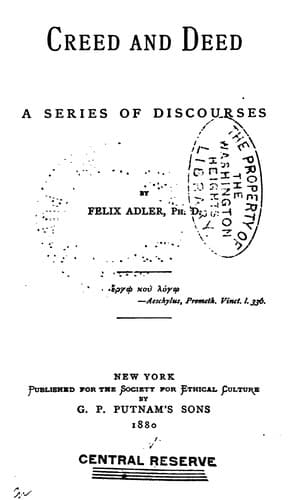
Creed and Deed: A Series of DiscoursesAdler, Felix
Religion
Creed and Deed: A Series of Discourses
Adler, Felix
Ethical culture movement; Ethics; Religion
Among the primitive races woman was reduced to a condition of abject
slavery. Affection of the deeper kind was unknown. The wife was robbed
or purchased from her relations; was treated as a menial by her husband,
and often exposed to the most brutal abuse. As civilization advanced,
the marriage bond became more firm, and common interest in the offspring
of the union served to create common sympathies. Among the Greeks, the
ideal of domestic life was pure and elevated. The tales of Andromache,
Penelope and Alcestes illustrate the strength of conjugal fidelity and
the touching pathos of love that outlasts death. The Grecian home was
fenced about with scrupulous care and strictest privacy protected its
inmates from temptation. It was the duty of the wife to superintend
the internal economy of the household, to spin and weave, to direct the
slaves in their various occupations, to nurse them when sick, to
watch over the young children, and chiefly to insure the comfort and
satisfaction of her lord. His cares and ambitions indeed she hardly
shared. She never aspired to be his equal, and simple obedience to
his wishes was the supreme virtue impressed upon her by education, and
enforced by habit. Among the Romans, the character of the matron is
described in the most laudatory and reverential terms. Still the laws
of the Republic made woman practically the bondswoman of man. It is
well-known that our English word family is derived from the Latin
where it originally means the household of slaves. The matron too, was
counted, at least theoretically, among these slaves, and the right of
deciding her fate literally for life or death, belonged exclusively to
her husband. It is true in the cordial intimacy of the monogamic bond,
the austerity of usage, and the harshness of the laws are often tempered
by affection and mutual respect; yet we are aptly reminded by a modern
writer on this subject, that the law which remains a dead letter to
the refined and cultivated becomes the instrument of the most heartless
oppression in the hands of the vulgar and the passionate.
Public-domain text, read in full here on John Shaqi.
Reviews
Reviews
No reviews yet
Be the first to share your thoughts on this work.
Elsewhere in the archive
Join the Discussion
Join the discussion
Sign in to leave a comment or review.
Sign InorCreate an account