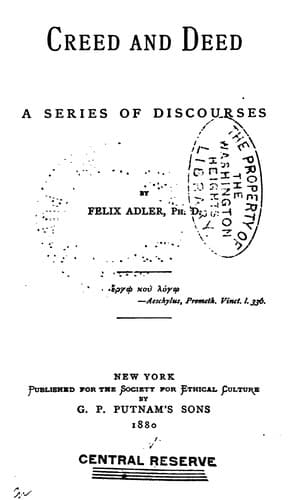
Creed and Deed: A Series of DiscoursesAdler, Felix
Religion
Creed and Deed: A Series of Discourses
Adler, Felix
Ethical culture movement; Ethics; Religion
Among the Hebrews, a position of great dignity and consequence was
sometimes accorded to their women. The wives of Abraham, Isaac and Jacob
played an important part in directing the affairs of the Patriarchal
households. A woman performed the functions of judge and leader of
armies, women sat upon the throne, prophetesses were consulted in grave
matters of the State and of religion; in the absence of sons, the
Mosaic law guarantees to daughters the right of succession to the family
estate. The later writings of the Jews are likewise replete with noble
sentiments touching the sanctity of the conjugal tie. Many of the
ordinances of the Talmud depend upon women for their execution, and this
circumstance alone must have contributed to raise them in the popular
estimation. In every marriage contract a certain sum was set apart for
the wife, in case of her husband's death or of divorce. Still the right
of dissolving the matrimonial connection belonged exclusively to the
husband, although under certain conditions he could be forced by the
court to issue the "writ of separation." However the wife might be
honored and loved, she was ever regarded as man's inferior.
The influence of Christianity upon the position of women, was twofold,
and in opposite directions. On the one hand women had been among
the first and most devoted followers of Jesus; women were largely
instrumental in effecting the conversion of the Roman Empire, and in the
list of martyrs, their names shine preeminent. On the other hand, the
church in the early centuries cast an unpardonable slur on the
marriage relation. We read of young maidens fleeing the society of dear
companions and friends, to escape the temptation of the affections, of
faithful wives, filled with inexpressible loathing at a connection which
they deemed contrary to the dictates of religion, and deserting husbands
and children. The desire of love was poisoned with a sense of guilt. The
celibacy of the clergy, finally enforced by Pope Hildebrand, gave rise
to the most shocking irregularities. All this tended to degrade the
female sex.
At the time of the crusades a partial revulsion of feeling took place.
The spirit of chivalry entered the church, the character of woman was
transfigured, and the worship of the Virgin Mary spread in consequence
throughout Europe. A change in the education of girls was one of the
results of the rise of Chivalry. Music and poetry became its chief
elements; women were fed on intellectual sweetmeats, but strong and
healthy nourishment was still denied them.
In all the different stages of progress which we have thus rapidly
scanned, the assumption of man's superiority to woman was held as an
incontestible article of belief, and even the chivalric ideal is only a
more amiable and disguised expression of the same view.
Public-domain text, read in full here on John Shaqi.
Reviews
Reviews
No reviews yet
Be the first to share your thoughts on this work.
Elsewhere in the archive
Join the Discussion
Join the discussion
Sign in to leave a comment or review.
Sign InorCreate an account