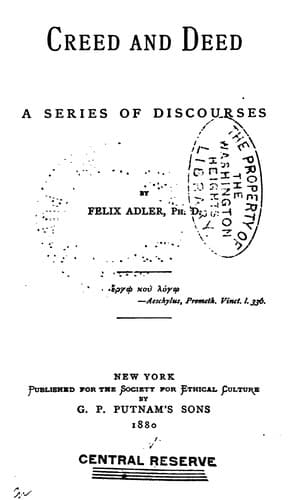
Creed and Deed: A Series of DiscoursesAdler, Felix
Religion
Creed and Deed: A Series of Discourses
Adler, Felix
Ethical culture movement; Ethics; Religion
Among the means of consolation commonly recommended the doctrine of
Immortality seems to be regarded as the most appropriate and effective.
It is needless to lament; the deceased has entered a better life. Yet a
little and you will join him to be no more parted. Nor can we deny that
to those who cordially entertain it, the belief in the soul's
immortal continuance becomes a source of pure and inexpressibly tender
satisfaction. But with a certain class of minds--and their number, I
believe, is on the increase--the consoling influence of this doctrine is
marred by the fatal uncertainty in which the whole question is involved,
and which no efforts of man have ever yet, nor ever will, avail to
remove. Christianity indeed claims to have settled the point. The Deity
himself, it avers, intervened by direct revelation from on high, to set
our doubts at rest, and Jesus when he arose on the third day forever
deprived the grave of its sting and took away our fears of the tomb. But
to those who read the books of revelations with unbiased mind, the fact
of their human authorship becomes sadly apparent, and the resurrection
itself is as difficult to prove as the doctrine which it is designed to
substantiate.
In modern times spiritualism has likewise endeavored to demonstrate to
the senses the existence of a world of souls beyond our own. But
the phenomena on which it lies are in part disputed, in part the
interpretation put upon them, must, to say the least, be regarded as
premature.
Moreover we should remember that even if by some unknown means the fact
of immortality could be established, the question of our re-union with
friends in the hereafter, in which alone the heart of the mourner is
interested, would still remain an open one and might be answered in the
negative. The belief in immortality has been held in this way by some of
the greatest intellects of the human race, Spinoza among the rest. If we
knew that we shall continue to live, we should not therefore know how
we shall continue to live. Perhaps it might prove that all our previous
connections would be severed; and who can tell what new phases of
existence, what endless metamorphoses might await us among the infinite
possibilities of Eternity.
Public-domain text, read in full here on John Shaqi.
Reviews
Reviews
No reviews yet
Be the first to share your thoughts on this work.
Elsewhere in the archive
Join the Discussion
Join the discussion
Sign in to leave a comment or review.
Sign InorCreate an account