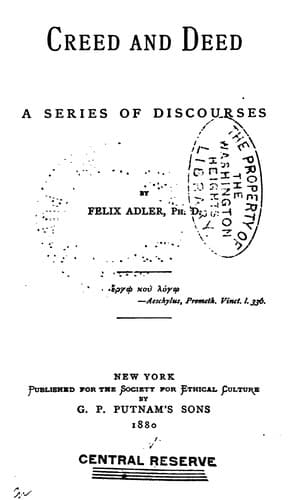
Creed and Deed: A Series of DiscoursesAdler, Felix
Religion
Creed and Deed: A Series of Discourses
Adler, Felix
Ethical culture movement; Ethics; Religion
So deep seated is the sense of uncertainty concerning our fate beyond
the tomb, that no religion, however great the control which it exerted
over men, has ever been able to banish it entirely from their hearts.
The most ardent Christian is hardly less anxious than the infidel to
retain those who are dear to him in life. He prays as fervently for
their health as though their present state were the sum total of their
existence. And yet he should rather hail the day of death as a day of
thanksgiving, and rejoice that those whom he loves have been translated
to a sphere every way so much more desirable than our own. No, the
natural feeling cannot be suppressed, loss is felt to be loss, and death
remains death. No hope of a happier condition in the world to come, no
confidence in the promises and prophesies of faith, can efface the sense
of present bereavement, and as we all alike feel it, so are we all,
believers and unbelievers, interested in seeking the means of its
present relief.
Some of the most fervid, religious natures of the past endeavored to
escape the sorrows of the world by having recourse to the cruel remedy
of asceticism. The ascetic ponders the origin of suffering; he sees
that the desire for pleasure is the cause of pain. Were we not eager to
possess we should not regret to lose. He cuts the gordian knot saying,
abjure desire! When you cease to want, you shall no longer be bruised.
There are certain wants inherent in the body--the want of food,
drink, sleep; the heart has its needs--friendship, sympathy; the
mind--knowledge, culture. All these should be subdued. We should eat
and drink the coarsest in quality and the least possible in quantity; we
should avoid the attachments of love; we should be poor in spirit, and
despise wisdom. The ascetic ideal took firm root in Christianity at an
early period of its history. The extravagance of the Egyptian anchorites
is well known. The "pillar saint," St. Simeon, who is said to have
passed some thirty years of his life on the summit of a column twenty
yards in height, taking only the scantiest nourishment, eschewing
ablutions, covered with filth and sores, was worshipped as a holy man by
the multitude and his example was followed by others, though with less
rigor, during a period of nearly a thousand years. Among the Hindoos,
too, the ascetic ideal acquired a baneful ascendency. We can hardly
credit the tales that have come to us concerning the insane fanaticism
which raged amongst this people. To what tortures of body and soul did
they subject themselves, what cruel ordeals did they invent in order to
steel themselves against the inevitable sufferings of life. It was their
beau-ideal to achieve a state bordering upon absolute unconsciousness,
in which the power of sensation might be entirely blunted, and even the
existence of the physical man be forgotten.
Public-domain text, read in full here on John Shaqi.
Reviews
Reviews
No reviews yet
Be the first to share your thoughts on this work.
Elsewhere in the archive
Join the Discussion
Join the discussion
Sign in to leave a comment or review.
Sign InorCreate an account