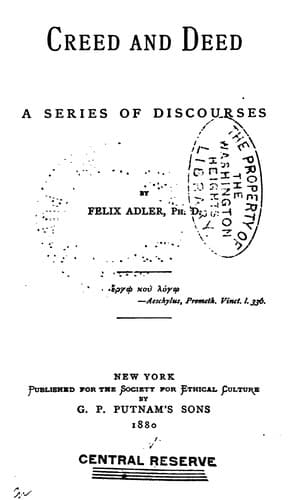
Creed and Deed: A Series of DiscoursesAdler, Felix
Religion
Creed and Deed: A Series of Discourses
Adler, Felix
Ethical culture movement; Ethics; Religion
In this manner the sway of man's genius is
extended on earth. Already life is far easier than it was among our
ancestors ten thousand years ago; the epidemic is checked by wise
sanitary regulations, greater justice prevails in government, and the
means of happiness are extended over wider areas of the population. What
we thus behold realized on a partial scale, we conceive in our visions
of the future to be indefinitely prolonged, the course of development
leading to higher and higher planes, healthier conditions, wiser laws,
nobler manners. The moral order will thus increase on earth. The moral
order never is, but is ever becoming. It grows with our growth, and to
bring on the triumph of intellect over mechanism, of responsible
morality over irresponsible force, is our mission. The purpose of man's
life is not happiness, but worthiness. Happiness may come as an
accessory, we dare never make it an end. There is that striving for the
perfect within us: in it we live, by it we are exalted above the clod;
it is the one and only solace that never fails us, and the experience of
progress in the past, the hope of greater progress in the future, is the
redeeming feature of life. But the condition of all progress is
experience; we must go wrong a thousand times before we find the right.
We struggle, and grope and injure ourselves until we learn the uses of
things. Pain therefore becomes a necessity, but it acquires in this view
a new and nobler meaning, for it is the price humanity pays for an
invaluable good. Every painful sickness, every premature death, becomes
the means of averting sickness and death hereafter. Every form of
violence, every social wrong, every inmost tribulation, is the result of
general causes and becomes a goad in the sides of mankind, pressing them
on to correct the hoary abuses it has tolerated, the vicious principles
of government, education and economy to which it has conformed. Wide as
the earth is the martyrdom of man, but the cry of the martyr is the
creaking of the wheel which warns us that the great car of human
progress is in motion.
If we keep duly in mind the position which the human race occupies over
against nature, we shall not accuse fate. Fate is our adversary; we
must wrestle with it, we are here to establish the law of our own higher
nature in defiance of fate. And this is the prerogative of man, that he
need not blindly follow the law of his being, but that he is himself the
author of the moral law, and creates it even in acting it out. We are
all soldiers in the great army of mankind, battling in the cause of
moral freedom; some to fight as captains, others to do valiant service
in the ranks; some to shout the paean of victory, others to fall on the
battle field or to retire wounded or crippled to the rear. But as in
every battle so too in this, the fallen and the wounded have a share
in the victory; by their sufferings have they helped, and the greenest
wreath belongs to them.
Public-domain text, read in full here on John Shaqi.
Reviews
Reviews
No reviews yet
Be the first to share your thoughts on this work.
Elsewhere in the archive
Join the Discussion
Join the discussion
Sign in to leave a comment or review.
Sign InorCreate an account