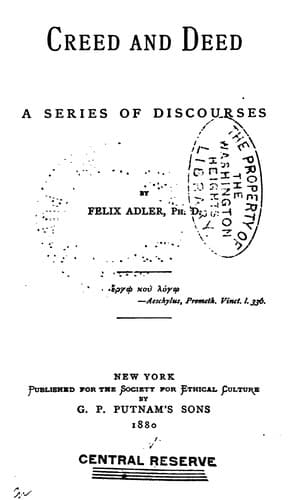
Creed and Deed: A Series of DiscoursesAdler, Felix
Religion
Creed and Deed: A Series of Discourses
Adler, Felix
Ethical culture movement; Ethics; Religion
Thus from whatever point we start, we arrive at the same conclusion
still: "not in the creed but in the deed!" In the deed is the pledge of
the sacredness of life; in the deed is the reward of our activities in
health; in the deed our solace, and our salvation even in the abysmal
gulfs of woe. In hours of great sorrow we turn in vain to nature for an
inspiring thought. We question the sleepless stars; they are cold
and distant: the winds blow, the rivers run their course, the seasons
change; they are careless of man. In the world of men alone do we find
an answering echo to the heart's needs. Let us grasp hands cordially and
look into each other's eyes for sympathy, while we travel together on
our road toward the unknown goal. To help one another is our wisdom, and
our renown, and our sweet consolation.
VIII. SPINOZA.
Two centuries have elapsed since Spinoza passed from the world of the
living, and to-day that high and tranquil spirit walks the earth once
more and men make wide their hearts to receive his memory and his name.
The great men whom the past has wronged, receive at last time's tardy
recompense.
On the day that Columbus set sail for America, the Jews left Spain in
exile. Many of their number, however, who could not find it in their
hearts to bid adieu to their native land, remained and simulated the
practice of devout Catholics while in secret they preserved their
allegiance to their ancestral religion. They occupied high places in the
church and state, and monks, prelates and bishops were counted in their
ranks. Ere long the suspicions of the Inquisition were alarmed against
these covert heretics, and their position became daily more perilous and
insecure. Some were condemned to the stake, others pined for years in
dungeons; those that could find the means, escaped and sought in distant
lands security and repose from persecution. It was especially the Free
States of Holland whose enlightened policy offered an asylum to the
fugitives, and thither accordingly in great numbers they directed their
steps. Their frugality, their thrift and enterprise, contributed not a
little to build up the prosperity of the Dutch metropolis.
Public-domain text, read in full here on John Shaqi.
Reviews
Reviews
No reviews yet
Be the first to share your thoughts on this work.
Elsewhere in the archive
Join the Discussion
Join the discussion
Sign in to leave a comment or review.
Sign InorCreate an account