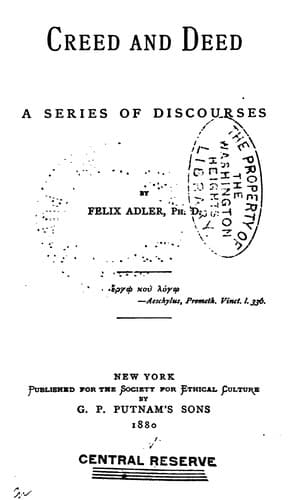
Creed and Deed: A Series of DiscoursesAdler, Felix
Religion
Creed and Deed: A Series of Discourses
Adler, Felix
Ethical culture movement; Ethics; Religion
In the opening of the seventeenth century a considerable congregation of
the Jews had collected in the city of Amsterdam. There in the year
1632, the child of Spanish emigrants, Benedict Spinoza was born. Of
his childhood we know little. At an early age he was initiated into
the mysteries of Hebrew lore, was instructed in the Hebrew grammar, and
learned to read and translate the various writings of the Old Testament.
He was taught to thread his way through the mazes of the Talmud, and its
subtle discussions proved an admirable discipline in preparing him for
the favorite pursuits of his after years. Lastly he was introduced to
the study of the Jewish philosophers, among whom Maimonides and Ibn Ezra
engaged his especial attention. Maimonides, one of the most profound
thinkers of the middle ages, strove to harmonize the teachings of
Aristotle with the doctrines of the Bible. Ibn Ezra on the other hand,
was a confirmed sceptic. In his biblical commentaries he anticipates
many noteworthy discoveries of modern criticism, and his orthodoxy in
other respects also is more than doubtful.
In all these different branches of theology the young Spinoza made rapid
progress and soon gained astonishing proficiency. He was the favorite
of his instructors, and they predicted that he would one day become a
shining light of the synagogue. Not content, however, with this course
of study, Spinoza addressed himself to the study of Roman literature,
and with the assistance of a certain Dr. Van den Ende, who had at that
time gained considerable repute as a teacher of liberal learning, he
soon became an accomplished Latin scholar. He also took up the study of
Geometry and of Physics, and acquired considerable skill in the art of
sketching. His mind being thus stored with various knowledge, he was
prepared to enter the vast realm of metaphysical speculation and
here the works of Rene Descartes, preeminently engaged his attention.
Descartes, whose motto, _De omnibus dubitandum est_, sufficiently
indicates the revolutionary character of his teachings, was the leader
of the new school of thought on the continent. His influence proved
decisive in shaping the career of Spinoza. Bruno also deserves mention
among those who determined the bias of Spinoza's mind. I mean that Bruno
was among the first followers of Copernicus, proclaimed the doctrine of
the infinity of worlds and who himself inculcated a species of pantheism
for which he paid the last penalty at Rome in the year 1600, thirty-two
years before Spinoza was born. By all these influences the mind of the
young philosopher was widened beyond the sphere of his early education.
In the pursuit of truth he sought the society of congenial minds, and
found among the cultivated Christians of his day that intellectual
sympathy of which he stood in need. From the high plane of thought
which he had now reached, the rites and practices of external religion
dwindled in importance, and the questions of creed for which the mass
Public-domain text, read in full here on John Shaqi.
Reviews
Reviews
No reviews yet
Be the first to share your thoughts on this work.
Elsewhere in the archive
Join the Discussion
Join the discussion
Sign in to leave a comment or review.
Sign InorCreate an account