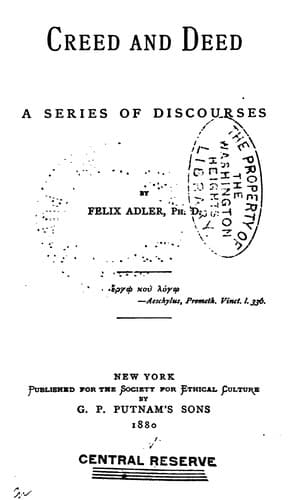
Creed and Deed: A Series of DiscoursesAdler, Felix
Religion
Creed and Deed: A Series of Discourses
Adler, Felix
Ethical culture movement; Ethics; Religion
On the 27th of July, 1656, in the synagogue of Amsterdam, the sacred
ark, containing the scrolls of the law, being kept open during the
ceremony, the edict of excommunication was solemnly promulgated. It
reads somewhat as follows:
"By the decree of the angels and the verdict of the saints we separate,
curse and imprecate Baruch de Spinoza with the consent of the blessed
God and of this holy congregation, before the holy books of the Law with
the commandments that are inscribed therein, with the ban with which
Joshua banned Jericho, with the curse with which Elias cursed the
youths, and with all the imprecations that are written in the Law.
Cursed be he by day and cursed by night; cursed when he lies down,
and cursed when he rises; cursed in his going forth, and cursed in his
coming in. May the Lord God refuse to pardon him; may his wrath and
anger be kindled against this man, and on him rest all the curses that
are written in this book of the Law. May the Lord wipe out his name
from under the heavens, and separate him for evil from all the tribes
of Israel, with all the curses of the firmament that are written in the
book of the Law. And ye that hold fast to the Lord God are all living
this day! we warn you that none shall communicate with him either by
word of mouth or letter, nor show him any favor, nor rest under the same
roof with him, nor approach his person within four yards, nor read any
writing that he has written."
When Spinoza heard of this anathema he calmly replied: "They compel me
to do nothing which I was not previously resolved upon." He retired
from the commerce of the world. He coveted solitude. Within his silent
chamber he moved in a world of his own. There in twenty years of patient
passionless toil he built up the mighty edifice of his system. It rises
before us as if hewn of granite rock. Its simplicity, its grandeur,
its structural power have been the wonder of men. I can offer only the
barest outline of its design.
Man's questioning spirit seeks to penetrate to the heart of Nature,
would grasp the origin of things. There is this mighty riddle: who will
solve it? Various attempts have been made. Pantheism is one. Spinoza was
the great philosopher of Pantheism.
Beneath all diversity there is unity. In all of Nature's myriad forms
and changes, there is a substance unchangeable. It is uncreated,
undivided, uncaused, the Absolute, Infinite, God. Thought and extension
are its attributes; it is the One in All, the All in One. God is not
matter, is not mind; is that deeper unity in which matter and mind are
one; God or Nature, Spinoza says. This is not the God of theology. God
is in the tree, in the stone, in the stars, in man. God does not live,
nor labor for any purpose, but produces from the necessity of his Being
in endless variety, in ceaseless activity. He is the inner cause of all
things, the ultimate Reality, and all things are as in their nature they
partake of him.
Public-domain text, read in full here on John Shaqi.
Reviews
Reviews
No reviews yet
Be the first to share your thoughts on this work.
Elsewhere in the archive
Join the Discussion
Join the discussion
Sign in to leave a comment or review.
Sign InorCreate an account