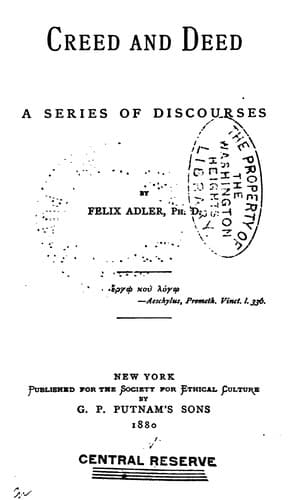
Creed and Deed: A Series of DiscoursesAdler, Felix
Religion
Creed and Deed: A Series of Discourses
Adler, Felix
Ethical culture movement; Ethics; Religion
Man also is of God. The essence of man is in the mind. Man is a logical
being. God alone owns truth; in so far as man thinks truly and clearly,
he is a part of the infinite God. Logic is the basis of ethics. Spinoza
ignores sentiment, ignores art. Good and evil are but other names for
useful and not useful. But that alone is useful that we follow the
necessary and universal laws, seeking by the depth and reach of
intellect to know and understand.
Virtue is the pursuit of knowledge. There are three kinds of knowledge:
the blurred perceptions of the senses, the light of the understanding,
the intuition of intellect. The last is the highest.
Virtue is the sense of being; whatever heightens the joyous
consciousness of our active faculties is therefore good. The wise man
delights in the moderate enjoyment of pleasant food and drink, in the
color and loveliness of green shrubs, in the adornment of garments, in
music's sweetness. But our true being is to be found only in intellect;
hence, virtue the joy of being, is the joy of thought; hence, the bold
assertion--that is moral which helps, and that immoral which hinders
thought.
Man is a social being. As a drop is raised upward in the great ocean
by the onflowing of the wave, so the individual mind is exalted by the
presence and communion of congenial minds moving in the same current.
'Tis thus that Spinoza deduces the social virtues. Hate is evil at all
times, for hate implies the isolation and the weakness of the powers of
reason. We should reward hatred with love and restore the broken accord
of intellect. Love is the sense of kinship in the common search for
reason's goal--wisdom. That all men should so live and act together that
they may form, as it were, one body and one mind, is the ideal of life.
Friendship therefore he prizes as the dearest of earth's possessions,
and wedlock he esteems holy because in it is cemented the union of two
souls for the common search of truth. We should be serene at all times
and shun fear, which is weakness, and hope also which is the child of
desire, and haughtiness and humbleness and remorse and pity should we
avoid. But in stillness and with collected power shall we possess our
souls obedient to the laws of mind that make our being and helping when
we help for reason's sake. The passions bind us to passing phenomena.
When they become transparent to our reason, when we know their causes
then our nature conquers outward nature and we are masters, we are free.
Thus the emotional life is extinguished. The feelings lose their color
and vitality, become blank "as lines and surfaces," and man, freed from
the constraints of passion, dwells in the pure realm of intellect, and
in constant intercourse with the mind of God, fulfills the purpose of
his existence--to know and understand.
Public-domain text, read in full here on John Shaqi.
Reviews
Reviews
No reviews yet
Be the first to share your thoughts on this work.
Elsewhere in the archive
Join the Discussion
Join the discussion
Sign in to leave a comment or review.
Sign InorCreate an account