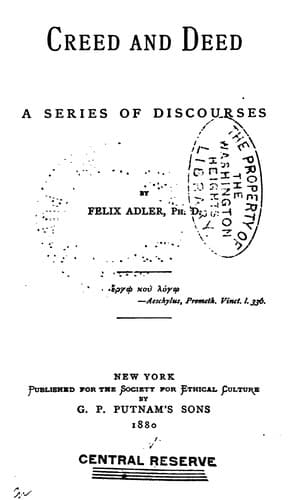
Creed and Deed: A Series of DiscoursesAdler, Felix
Religion
Creed and Deed: A Series of Discourses
Adler, Felix
Ethical culture movement; Ethics; Religion
To grasp the subtle essence of that charm, and thereby to understand
what it was that has given Christianity so powerful a hold upon
the affections of mankind, were a task well worthy the attention of
thoughtful minds. We desire to approach our subject in the spirit of
reverence that befits a theme with which the tenderest fibres of faith
are so intimately interwoven; at the same time we shall pay no regard
to the dogmatic character with which his later followers have invested
Jesus, for we behold his true grandeur in the pure and noble humanity
which he illustrated in his life and teachings.
The New Testament presents but scant material for the biography of
Jesus, and the authenticity, even of the little that remains to us, has
been rendered extremely uncertain by the labors of modern critics. A few
leading narratives, however, are doubtless trustworthy, and these will
suffice for our purpose. A brief introduction on the character of the
people among whom the new prophet arose, the characteristics of the
age in which he lived, and the beliefs that obtained in his immediate
surroundings, will assist us in our task.
The expectation of the Messiah had long been rife among the Jews.
Holding themselves to be the elect people of God, they believed the
triumph of monotheism to be dependent upon themselves. The prophets of
Jehovah had repeatedly assured them that their supremacy would finally
be acknowledged. Events however had turned out differently. Instead of
success they met with constant defeat and disaster; Persia, Egypt, Syria
had successively held their land in subjection; the very existence of
their religion was threatened, and the heathen world, far from showing
signs of approaching conversion, insisted upon its errors with increased
obstinacy and assurance. And yet Jehovah had distinctly promised that he
would raise up in his own good time, a new ruler from the ancient
line of Israel's Kings, a son of David, who should lead the people to
Victory. To his sceptre all the nations would bow, and in his reign the
faith of the Hebrews would be acknowledged as the universal religion.
Every natural means for the fulfilment of these predictions seemed now
cut off, nothing remained but to take refuge in the supernatural; it was
said that the old order of things must entirely pass away; a new heaven
and a new earth be created and what was called the Kingdom of Heaven
might then be expected. The "Kingdom of Heaven," a phrase that
frequently recurs in the literature of the Jews, is used, not to
describe a locality, but to denote a state of affairs on earth, in
which the will of heaven would be generally obeyed without the further
intervention of human laws and government. The agency of the Messiah was
looked to, for the consummation of these happy hopes. To reward those
who had perished before his coming, many moreover of those that slept
in the dust would awaken, and the general resurrection of the dead would
Public-domain text, read in full here on John Shaqi.
Reviews
Reviews
No reviews yet
Be the first to share your thoughts on this work.
Elsewhere in the archive
Join the Discussion
Join the discussion
Sign in to leave a comment or review.
Sign InorCreate an account