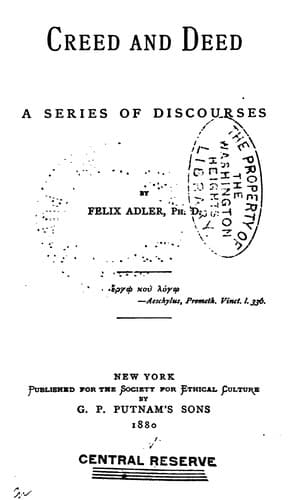
Creed and Deed: A Series of DiscoursesAdler, Felix
Religion
Creed and Deed: A Series of Discourses
Adler, Felix
Ethical culture movement; Ethics; Religion
He has left a name in history that will not fade. His people cast him
out, Christianity rejected him, but he has found a wider fellowship, he
belongs to all mankind. Great hearts have throbbed responsive to his
teachings and many a sorrowful soul has owned the restful influence of
his words. He was a helper of mankind. Not surely because he solved the
ultimate problems of existence--what mortal ever will--but because he
was wise in the secret of the heart, because he taught men to appease
their fretful passions in the aspect of the infinite laws in which we
live and are.
Sacred is the hour in which we read his Ethics. From the heat and glare
of life we enter into its precincts as into the cool interior of some
hallowed temple of religion. But no idol stands there; the spirit of
truth alone presides and sanctifies the place and us. The great men
of the past we will reverence. They are mile-stones on the highway of
humanity, types of the Infinite, that has dawned in human breasts. Such
an one was he of whom I have spoken. And more and more as the light
increases among men will all that was good and great in him shine forth
to irradiate their path. And as we stand here to-day on this day of
remembrance to recall his teachings and his example, so when other
centuries shall have elapsed, the memory of Spinoza will still live,
posterity will still own him, and distant generations will name him
anew: Benedictus--Blessed!
IX. THE FOUNDER OF CHRISTIANITY
{A discourse delivered on Sunday, December 31, 1876.}
"I am not come to destroy, but to fulfil, for verily I say unto you till
heaven and earth pass away one jot or one tittle shall in no wise pass
from the law till all be fulfilled." "Resist not evil, * * * bless them
that curse you, do good to them that hate you."
In these sayings of Jesus the key note of early Christianity is struck.
It was not a revolt against Judaism, it was but a reiterated assertion
of what other and older Prophets of the Hebrews had so often and so
fervently preached. The law was to remain intact, but the spiritual
law was meant, the deeper law of conscience that underlies the forms of
legislation and the symbols of external worship.
There is a rare and gracious quality in the personality of Jesus as
described in the Gospels, which has exercised its charm upon the most
heterogeneous nations and periods of history wide apart in the order of
time and of culture.
Public-domain text, read in full here on John Shaqi.
Reviews
Reviews
No reviews yet
Be the first to share your thoughts on this work.
Elsewhere in the archive
Join the Discussion
Join the discussion
Sign in to leave a comment or review.
Sign InorCreate an account