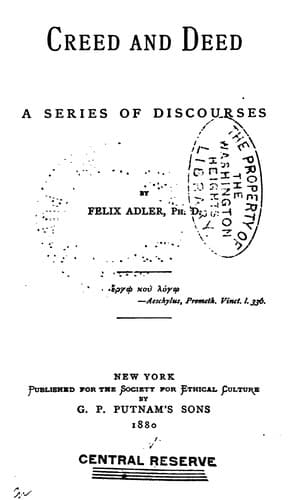
Creed and Deed: A Series of DiscoursesAdler, Felix
Religion
Creed and Deed: A Series of Discourses
Adler, Felix
Ethical culture movement; Ethics; Religion
Conscience, righteousness, what is there new in these--their maxims
are as old as the hills? Truly, and as barren often as the rocks. The
novelty of righteousness is not in itself, but in its novel application
to the particular unrighteousness of a particular age. It was thus that
Jesus applied to the sins and mock sanctities of his day, the ancient
truths known to the prophets and to others long before him. It is
thus that every new reformer will seek to bring home to the men of his
generation what it is that the ancient standard of right and justice now
requires at their hands. That all men are brothers, who did not concede
it? But that the enslaved man too is our brother, what a convulsion did
that not cause, what vast expenditure of blood and treasure until that
was made plain. That we should relieve the necessities of the poor, who
will deny it? But that a social system which year by year witnesses the
increase of the pauper class, and the increase of their miseries, stands
condemned before the tribunal of Religion, of justice, how long will
it take before that is understood and taken to heart? The facts of
righteousness are few and simple, but to apply them how mighty, how
difficult a task. The time is approaching when this stupendous work
must be attempted anew, and we, a small phalanx in the army of progress,
would aid, with what power in us resides. Let this inspire us that we
have the loftiest cause of the age for our own, that we are helping
to pave the way for a stronger and freer and happier race. For by so
laboring, alone can we feel that our life has a meaning under the sky
and the sacred stars.
The year in which we have entered upon our journey is passing away.
To-night when the midnight bells send forth their clamorous voices, we
shall greet the new year, and the work it brings. No peaceful task dare
we expect, but something of good accomplished may it see.
"Ring out wild bells to the wild sky,
The flying cloud, the frosty light,
The year is dying in the night,
Ring out wild bells and let him die.
"Ring out the old, ring in the new,
Ring happy bells across the snow,
The year is going, let him go,
Ring out the false, ring in the true."
X. THE FIRST ANNIVERSARY DISCOURSE.
It is May, the gladdest season of the year. Life is in the breezes, life
in the vernal glory of the fields, life in the earth and in the skies.
Of old, men were wont to go forth at this time into the forest, to
wreath the fountains with garlands, to cover their houses with green
branches, with songs and dances to celebrate the triumph of the Spring.
Happy festivals, happy omens.
A year has now passed since we began our work, and for many months we
have met in this hall week after week. We have reached the first resting
place upon our journey, and it behooves us to look back once more upon
the path we have travelled, and forward into the yet untried future that
awaits us.
Public-domain text, read in full here on John Shaqi.
Reviews
Reviews
No reviews yet
Be the first to share your thoughts on this work.
Elsewhere in the archive
Join the Discussion
Join the discussion
Sign in to leave a comment or review.
Sign InorCreate an account