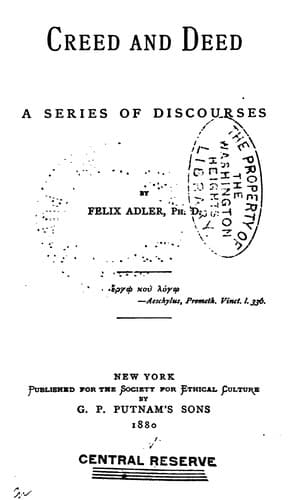
Creed and Deed: A Series of DiscoursesAdler, Felix
Religion
Creed and Deed: A Series of Discourses
Adler, Felix
Ethical culture movement; Ethics; Religion
What was it that induced us to enter upon so perilous and for many
reasons so uncertain an enterprise?
We felt a great need. Religion which ought to stand for the highest
truth, had ceased to be true to us. We saw it at war with the highest
intelligence of the day; religion and conscience also seemed no longer
inseparably connected, as they should be. We saw that millions are
annually lavished upon the mere luxuries of religion, gorgeous temples,
churches and on the elaborate apparatus of salvation; we could not but
reflect that if one tithe of the sums thus set apart were judiciously
expended upon the wants of the many who are famishing, distress might
often be relieved, sickness averted, and crime confined within more
narrow boundaries. We saw around us many who had lapsed from their
ancient faith but still preserved the outward show of conformance,
encouraged in so equivocal a course, by the advice and example of noted
leaders in the churches themselves. We saw that the great tides of being
are everywhere sweeping mankind on to larger achievements than were
known to the past; only within the churches all is still and motionless;
only within the churches the obsolete forms of centuries ago are
retained, or if concessions to the present are made, they are tardy,
ungracious and insufficient. We beheld that the essentials of religion
are neglected, even while its accessories are observed with greater
punctiliousness than ever.
We were passing moreover through a period of momentous import in our
country's history. The nation had just entered upon the second century
of its existence, and the great recollections of what the fathers had
done and designed for the republic, were fresh in our minds. We recalled
the memorable words of Washington in his first inaugural address: "That
the national policy would be laid in the pure and immutable principles
of private morality." But we were startled to observe how greatly recent
events had falsified these hopes and felt it our duty, within our own
limited sphere, to restore something of that noble simplicity, something
of that high fidelity to righteousness which it is said adorned the
earlier days, and on which alone the fortunes of the state can rest
securely hereafter.
Public-domain text, read in full here on John Shaqi.
Reviews
Reviews
No reviews yet
Be the first to share your thoughts on this work.
Elsewhere in the archive
Join the Discussion
Join the discussion
Sign in to leave a comment or review.
Sign InorCreate an account