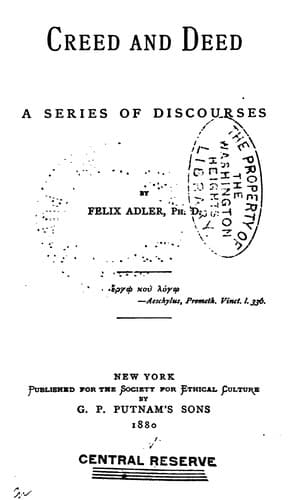
Creed and Deed: A Series of DiscoursesAdler, Felix
Religion
Creed and Deed: A Series of Discourses
Adler, Felix
Ethical culture movement; Ethics; Religion
We next proceeded to take up the study of the Hebrew Bible; for it is
evident that so long as this book is clothed with infallible authority,
arguments based on fact and logic avail nothing, and reason is helpless
before any random scriptural quotation. We examined the composition of
the work: we learned that many of those portions that are esteemed most
ancient, are of comparatively recent origin; that the text is studded
with discrepancies, and that the marks of savage and cruel customs such
as the offering of human sacrifices to the Deity, are still clearly
indented on the sacred volume. The conclusion followed that a book
so full of contradiction, so deeply tinged with the evidence of human
fallibility, could not have been the work of a divine author. The
inspiration theory being thus divested of its support, we considered how
baneful *had been its influence on the course of human history; how it
had retarded the progress of the Jews among whom it arose; how it had
checked the intellectual development of Europe, how it had hampered
the advancement of science; how it had offered a specious plea for the
despotism of kings, and of the holy Inquisition; how in our own days it
had become in the hands of the Southern slaveholders a most formidable
means of perpetuating their infamous scheme of oppression. We concluded
that whatever is false and worthless in the book we should feel at
liberty to reject, while what is great and holy would not therefore
become less great or less holy to us, because it was proven to be man's
work, man's testimony to the divine possibilities inherent in the human
soul.
We went on striving to penetrate more deeply the origin of that
mysterious power which we call religion. To us it appeared that the
feeling of the sublime is the root of the religious sentiment in man.
That the Vedahs, Avesta, Koran, Bible are the songs of the nations on
the theme of the infinite; and that the moral ideal, whether we endow
it with personality or not, presents to us the highest type of sublimity
and is the sole object worthy of religious reverence.
"Who dare express him And who profess him
Saying, 'I believe in him?'
Who feeling, seeing, deny his being
Saying I believe him not?
"Call it then what thou wilt
Call it bliss, heart, love,
God; I have no name to give it.
Feeling is all in all,
The name is sound and smoke."
We maintained lastly, that the entrance of the moral into the sphere
of religion has endowed the latter with whatever excellence it now
possesses.
Public-domain text, read in full here on John Shaqi.
Reviews
Reviews
No reviews yet
Be the first to share your thoughts on this work.
Elsewhere in the archive
Join the Discussion
Join the discussion
Sign in to leave a comment or review.
Sign InorCreate an account