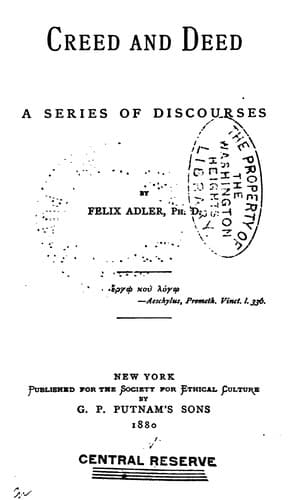
Creed and Deed: A Series of DiscoursesAdler, Felix
Religion
Creed and Deed: A Series of Discourses
Adler, Felix
Ethical culture movement; Ethics; Religion
What the exigencies of the modern age demand, more than aught else, is a
new movement for the moral elevation of the race. Now the basic facts of
man's moral nature, though insufficiently illustrated in practice, are
universally admitted among civilized human beings. Concerning them there
is and can be no dispute. Here then appeared the solid principle of our
union. The moral ideal would point the way of safety, the moral ideal
would permit us to preserve the sacred right of individual differences
intact, and yet to combine with our fellow-men for the loftiest and
purest ends. Taking the term creed therefore in its widest application,
we started out with the watchword, Diversity in the Creed, Unanimity in
the Deed. This feature, if any at all, lends character to our movement,
and by it would we be judged. We claim to be thereby distinguished, as
well from those religious corporations that base their organization upon
definite theological dogmas, as also from the great majority of Liberals
who meet for purposes of contemplation and poetical aspiration, in that
we put the moral element prominently forward and behold in it the bond
of our union, the pledge of our vitality.
But at the very threshold of our enterprise, we were met by the
objection that our main premise is false; that morality is impossible
without dogma, and that in neglecting the one we were virtually
neutralizing our efforts toward the other. It became our first and most
serious task therefore to show the futility of this objection, and to
make clear by an appeal to philosophy and history that the claims of
dogma are conditional, while the dictates of morality are imperative.
Then, having established the priority and supremacy of the moral law,
to examine what manner of substitute the ethical ideal can offer us to
replace the offices of the doctrinal religions; what are the hopes it
holds out, what its consolations, what it can give us for the priesthood
and the church. With this task we have been occupied during the year
that has gone by, and now, at the close, we propose to review once more,
the chief steps which we have taken in the course of our enquiry.
We discussed in the first place the doctrine of immortality, and some of
the main arguments upon which it is commonly founded.
Public-domain text, read in full here on John Shaqi.
Reviews
Reviews
No reviews yet
Be the first to share your thoughts on this work.
Elsewhere in the archive
Join the Discussion
Join the discussion
Sign in to leave a comment or review.
Sign InorCreate an account