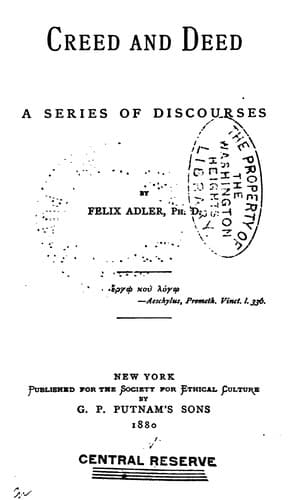
Creed and Deed: A Series of DiscoursesAdler, Felix
Religion
Creed and Deed: A Series of Discourses
Adler, Felix
Ethical culture movement; Ethics; Religion
O, if it were thine, America, America that hast given political liberty
to the world, to give that spiritual liberty for which we pant, to break
also those spiritual fetters that load thy sons and daughters! All over
this land thousands are searching and struggling for the better, they
know not what. Oh that we might aid them in the struggle, and they us;
and the hearts of many be knit together once more in a common purpose
that would lift them above their sordid, weary cares, and ennoble their
lives and make them glorious! The crops are waiting; may the reapers
come!
APPENDIX.
I. THE EVOLUTION OF HEBREW RELIGION.
"Dans l'opinion du peuple pour qui ces liyres ont ete ecrits
le point capital et essentiel n'est certes pas la narration
historiquc, mais bien la legislation et l'idification
religieuse."
In 1795, Frederick Augustus Wolf published a modest octavo volume
entitled "Prolegomena to Homer," from whose appearance is dated the
beginning of a new era of historic criticism. The composition of the
poems of Homer formed its subject. For wellnigh twenty years the author
had collected evidence, weighed arguments, and patiently tested his
results by constant revision. His own wishes were engaged on the side of
the unity of the great Grecian epic. But the results of his researches
continued to point in the opposite direction, and at last his earnest
devotion to truth compelled him to adopt a theory the soundness of whose
construction seemed to be no longer questionable. He was thus worthy
to become the "founder of the science of philology in its present
significance." ** The influence of Wolfs discovery was not confined to
the study of classic literature only.
* "In the estimation of the people for whom these books were
written, the capital, essential point surely was, not the
historic narrative, but rather legislation and religious
edification." (Noldeke, 'Histoire Litte'raire de l'Ancien
Testament,' p. 19.)
** Bonitz, "Ueber den Ursprung der Homerischen Gedichte."
Public-domain text, read in full here on John Shaqi.
Reviews
Reviews
No reviews yet
Be the first to share your thoughts on this work.
Elsewhere in the archive
Join the Discussion
Join the discussion
Sign in to leave a comment or review.
Sign InorCreate an account