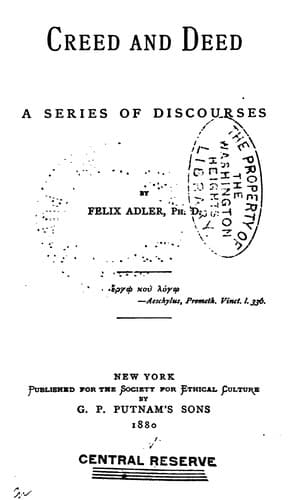
Creed and Deed: A Series of DiscoursesAdler, Felix
Religion
Creed and Deed: A Series of Discourses
Adler, Felix
Ethical culture movement; Ethics; Religion
It quickly radiated through every department of history. "In every
singing age," he said, "a single saeculum is almost like a single man.
It is all one mind, one soul."* This conception involved a new social
law, and radically altered the current opinions concerning the relation
of individual effort to the larger forces that affect the development
of nations. The creative energy of remarkable minds was not, indeed,
lessened in importance, but spontaneity, in this connection, acquired
a new meaning; and for the _Deus ex machina_ of the olden time
was substituted the cumulative force of centuries of progressive
advancement, culminating, it is true, at last in the triumphant
synthesis of genius. The commotion which the Wolfian theory has stirred
up in the literary world is largely due to the wide range of ideas
which it affected. Yet it was itself but a part of that general movement
which, toward the close of the last century, became conspicuous in its
effects on every field of human inquiry. Everywhere the shackles of
authority were thrown off, and, in place of blindly accepting the
testimony of the past, men turned to investigate for themselves. A new
principle of research was everywhere acknowledged, a new method
was created, and science, natural and historical, entered upon that
astonishing career of discovery whose rich promise for the future we
have but begun to anticipate.**
* In a letter given in Kttrte's "Leben und Studien F. A
Wolf s." i., p. 307.
** Scientific pursuits are distinguished from others, not by
the material, but by the method of knowledge. The mere
collection of data, however multiplied in detail, however
abstruse the subjects to which they may refer, does not of
itself deserve the name of science. The term properly
applies only when phenomena are placed in causal relation,
and the laws which govern their development are traced.
Measured by this standard, every attempt to explain the
growth of human thought and institutions, and to elucidate
the laws which have acted in the process of their evolution,
has a just claim to be classed under the head of scientific
inquiry.
Public-domain text, read in full here on John Shaqi.
Reviews
Reviews
No reviews yet
Be the first to share your thoughts on this work.
Elsewhere in the archive
Join the Discussion
Join the discussion
Sign in to leave a comment or review.
Sign InorCreate an account