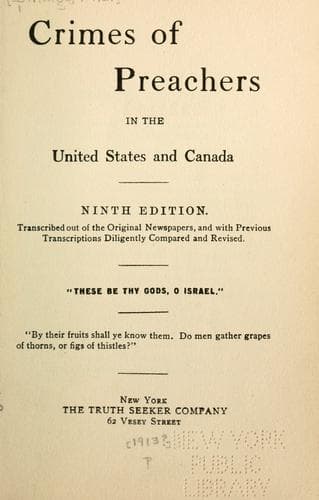
Crimes of Preachers in the United States and CanadaBillings, M. E.
Religion
Crimes of Preachers in the United States and Canada
Billings, M. E.
Clergy -- Malpractice -- Canada; Clergy -- Malpractice -- United States; Criminals -- Canada; Criminals -- United States
Wherever a reform is attacked by the clergy on moral grounds
the usefulness of this work is appreciable. In Pittsburgh, Pa.,
the secretary of a Socialist group was debating with a prominent
Presbyterian minister, when the preacher incautiously asserted that
Socialism would break up the home, and paraded the horrible example
of a Socialist professor who had been divorced by his wife. The
proponent of Socialism, expressing his regrets that so irrelevant a
matter had been brought into the argument, produced a copy of "Crimes
of Preachers" to show how the home had fared at the hands of men of
his opponent's profession.
Incidentals to the downfall of the preachers are sometimes
dramatic. One exhorted his congregation to confession and repentance,
whereupon his contrite landlady, much moved, made public the
fact that she had been living with him in adultery, and asked for
prayers. Another, having worked his hearers to the proper condition,
said: "Let us all lay our sins upon the altar." A young woman with
an infant in her arms came forward and, handing him the baby, said:
"Here's yours." It appeared that he was the father of the child,
though not married to the mother.
Reference has been made to the papal decree, which of late years
has shown renewed capacity for mischief, protecting a priest from
prosecution by any Catholic without a bishop or other superior's
consent. It is a survival of the "benefit of clergy" law under which
the church claimed the right to try the cases of clerical offenders,
instead of letting them go before the civil courts. The working of this
decree was illustrated in New York recently when a priest attempted
an immoral act with an eight or ten-year-old girl. The mother of the
girl, unmindful of the prohibition, reported the case to the police,
and caused the lecherous clergyman's arrest, but later, having been
advised by one of the higher clergy of the diocese, withdrew the charge
and declined to testify against the accused, who appears to have been
liberated after a reprimand by the court. It must be obvious that
with this rule in force, all but the most serious offenses of the
Catholic clergy will escape public notice. When in 1913 the murder
of Anna Aumuller had been traced to the Rev. Hans Schmidt, a priest
of a New York church, the police arrested and the courts convicted
the reverend criminal; yet the Rev. Hans Schmidt had committed other
crimes previous to this, and was known by his Catholic acquaintances to
be a man of immoral life. He enjoyed, however, the benefit of clergy,
and was protected by it from the exposure that would have come earlier
but for the Catholic ban on "scandal," and that would not have come
at all but for his sensational crime. With this wall of secrecy thrown
about the priestly life, we know not what immoralities and crimes take
place among the clergy and never come to light. While this edition of
"Crimes of Preachers" is in preparation a Chicago Catholic priest,
Public-domain text, read in full here on John Shaqi.
Reviews
Reviews
No reviews yet
Be the first to share your thoughts on this work.
Join the Discussion
Join the discussion
Sign in to leave a comment or review.
Sign InorCreate an account