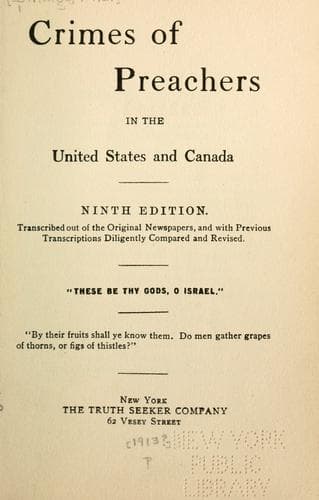
Crimes of Preachers in the United States and Canada — John Shaqi
Crimes of Preachers in the United States and CanadaBillings, M. E.
Religion
Crimes of Preachers in the United States and Canada
Billings, M. E.
Clergy -- Malpractice -- Canada; Clergy -- Malpractice -- United States; Criminals -- Canada; Criminals -- United States
Catholics do not have so many clergymen in proportion to their
communicants as the Protestant sects. With them one priest has to
serve a thousand adherents (provided they have the sixteen million
communicants they claim), while the Baptists, with less than six
million communicants, have nearly forty-three thousand ministers, and
the Methodists, with seven million members, report upwards of forty-one
thousand ministers. With such a multiplication of pulpiteers and a
low standard of qualification for the ministry, the bad preeminence
of the Methodist parsons is explained. It has been noticed already
that priests are not publicly exposed in such peccadilloes as might
cost a Protestant minister his pulpit or a layman his standing in
the community.
It cannot be inappropriate to quote the following comment on an excuse
offered for the two delegates to the Methodist conference of 1912,
who were caught with the broken fragments of the seventh commandment
on their person, or rather almost in the act of breaking them:
"The fact that two of the ministers who attended the late
Methodist conference in Indianapolis committed the statutory
offense before they went home led Pastor Dinsmore of the Baptist
church of Anderson, Ind., to which state one of the delinquents
belonged, to deliver a discourse on the theme, 'How Preachers
Go Wrong.' Viewing the matter historically, as was his duty,
the Rev. Mr. Dinsmore found that the going wrong of a preacher
is by no means a modern innovation; for did not Micah, David,
Eli, and Abiathar prove false to the trust imposed in them? The
preacher blamed society for protecting the preacher in his sin,
and for not giving him away. But the first cause, he says, why
a preacher falls is that he is 'human,' and the devil works for
mastery over him as over other souls. And the second cause of the
preacher's fall, we are told, is the woman (nothing said about
her being also 'human'). The religious woman who has missed her
man finds him in Jesus and takes the parson as his deputy. The
women tempt the preacher also by the cut of their clothes, says the
Rev. Mr. Dinsmore. They wear and let their daughters wear gowns so
low in the neck and so short in the skirt that when a man looks at
them 'hell is stirred up' in his breast. And so on. Of course some
of it is true; the minister is exposed to temptation, but if he
cannot resist what the Infidel has to, what is his religion for?"
The light sentences, if any, imposed upon clergymen in many instances
having been alluded to, we may allege a concrete case. It occurred
at the time when a nation-wide attempt was being made to fasten the
crime of white slavery, with its penalties, on two laymen who had
taken two women with their consent into an adjoining state and there
cohabited with them. The clerical case was as follows (we quote an
editorial paragraph in "The Truth Seeker" for July 19, 1913):
Public-domain text, read in full here on John Shaqi.
Reviews
Reviews
No reviews yet
Be the first to share your thoughts on this work.
Join the Discussion
Join the discussion
Sign in to leave a comment or review.
Sign InorCreate an account