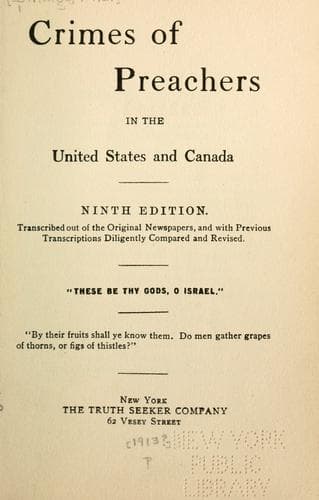
Crimes of Preachers in the United States and Canada — John Shaqi
Crimes of Preachers in the United States and CanadaBillings, M. E.
Religion
Crimes of Preachers in the United States and Canada
Billings, M. E.
Clergy -- Malpractice -- Canada; Clergy -- Malpractice -- United States; Criminals -- Canada; Criminals -- United States
The clergy assume to be the teachers and guardians of morality, and
assert not only that belief in their astonishing creeds is necessary
to an upright life, but, by implication, that a profession of faith
is in a sense a guarantee of morality. It has become traditionary
with them to assume that the non-Christian man is an immoral man;
that the sincere believer is the exemplar of the higher life, while
the "Infidel," the unbeliever, illustrates the opposite; and that
whatever of morality the civilized world enjoys today it owes to the
profession and practice of Christianity.
Now, it is wholly legitimate that systems should be judged by the
correspondence between the claims made for them and their actual
performances. When Mrs. Eddy, for an instance, rose up and asserted
that Christian Science was the key to health, investigation into the
health of persons professing and practicing Christian Science became
at once a proper inquiry. And so, when ministers exalt the belief
and practice of Christianity as the one highway to the moral life of
individuals and nations, it is equally germane to observe with some
care whether or not the clergy make good their claims in their own
persons. The inquiry would be of great interest and permissible even
were Christianity offered only for our free acceptance or rejection;
but the investigation assumes the binding nature of a civic duty
when, on the strength of these clerical pretensions, the preachers of
Christianity claim and are allowed to enjoy privileges and immunities
from the state that are not granted to other citizens. There are many
"benefits of the clergy" besides those bestowed on them personally
in the shape of half-fares, freedom from civic and military duties,
and the license under the papal decree which forbids that any priest
shall be brought into a civil or criminal court without the approval
of his ecclesiastical superior. In the United States church property
valued at a billion and a half dollars escapes taxation on the
plea that it is devoted to improving the morals of the community,
and the ministers have a virtual monopoly of the first day of the
week, commonly called Sunday, on the strength of the same unproved
theory. The plea is questioned and denied by the publishers of this
book, who quote the evidences in disproof, among these being the fact
of the immorality of the clergy themselves. If the religion they spend
their lives in expounding does not keep the ministers straight, it
is almost useless to ask how much restraining influence that religion
has on the laity who only listen once a week.
Public-domain text, read in full here on John Shaqi.
Reviews
Reviews
No reviews yet
Be the first to share your thoughts on this work.
Join the Discussion
Join the discussion
Sign in to leave a comment or review.
Sign InorCreate an account