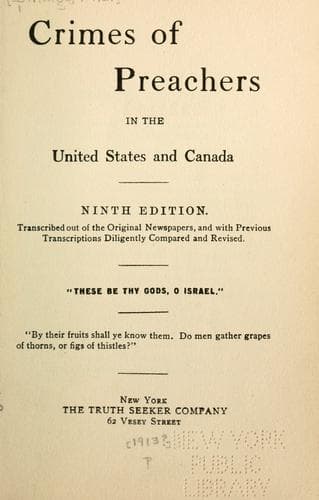
Crimes of Preachers in the United States and CanadaBillings, M. E.
Religion
Crimes of Preachers in the United States and Canada
Billings, M. E.
Clergy -- Malpractice -- Canada; Clergy -- Malpractice -- United States; Criminals -- Canada; Criminals -- United States
In proportion to their numbers, it is believed, more ministers than
members of any other profession are guilty of crimes and vices. A
large portion of the crimes are against women or with women. This,
perhaps, is not strange when one considers the institution of pastoral
visits. While men are away from home attending to their duties in
life, the minister is roving about, pretendedly looking after the
welfare of his flock, but really making calls upon the women who most
attract him. What the confessional is to the Roman Catholic church,
such is the "pastoral visit" to the Protestant church. Women should not
attend the one or receive the other except in the presence of their
fathers or husbands. Another institution of the church could also
be done away with to the gain of morality--to wit, the lone studies
for the minister annexed to the churches. These furnished rooms are
the scenes of many debaucheries. With them, too, should go the side
doors or choir entrances. The side door and study of a church in
San Francisco were used for assignation purposes, which culminated
in murder. A murdered woman was found at the confessional box of a
Romish church in New York city. In Omaha a minister was found in the
pastor's room of his own church asphyxiated in close embrace with a
woman missionary. These side doors, secluded "studies," and secret
confessional boxes are dangerous to virtue if not to life. Many a
woman and girl passes through them to her downfall.
In this short history of ministerial conduct, lack of complete identity
is sometimes unavoidable, for in the reports of these trials in the
secular journals it has been customary to drop the first names of the
defendant, and many a pious villain is recorded as "Rev. Mr. Smith,"
or "Rev. Mr. Jones." In some cases the place is not fully given where
the crime was committed. Again, in certain instances, the offense
receives the laconic name, applied by the ecclesiastical court which
tried the criminal, as "immoral conduct," "lascivious conduct," etc.;
definitions that hide the grossness of the offense, and so screen
the reverend culprit in the interest of the church and the cloth. In
many reports of trials by ecclesiastical gatherings the name of the
accused is entirely suppressed, as is supposed, out of respect for his
"sacred calling."
The denomination to which the "pious soul" belonged, is not always
given, consequently this record will not do to rely upon to enable
the reader to ascertain what branch of "the church of God" has shown
the most efficiency in pastoral criminality.
Public-domain text, read in full here on John Shaqi.
Reviews
Reviews
No reviews yet
Be the first to share your thoughts on this work.
Join the Discussion
Join the discussion
Sign in to leave a comment or review.
Sign InorCreate an account