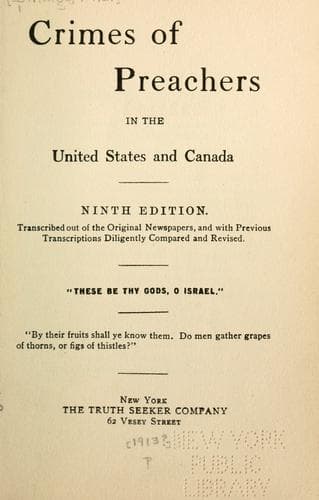
Crimes of Preachers in the United States and Canada — John Shaqi
Crimes of Preachers in the United States and CanadaBillings, M. E.
Religion
Crimes of Preachers in the United States and Canada
Billings, M. E.
Clergy -- Malpractice -- Canada; Clergy -- Malpractice -- United States; Criminals -- Canada; Criminals -- United States
"A list of ministers, guilty of crimes and immoralities, though of
unimpeached orthodoxy, is the answer to this class of falsifying
preachers, which any court must accept as historical and lawful
evidence against the pretense that good conduct grows out of
belief in Christianity. It shows that the very apostles of that
religion go wrong, that its ministers are profligate, and that
in these the theory is condemned before we come to its mere lay
exponents who less perfectly understand it.
"People have been taught so long that piety and morality are
interchangeable terms, that they believe it without regard to the
facts which demonstrate the contrary to be true. When an individual
of reputed orthodoxy violates the moral law they accuse him of
being a hypocrite and set his religious professions down as mere
outward pretense. But here their mental narrowness is shown, for
the immoral person may be thoroughly sincere. The more firmly
he believes, the stronger may be his confidence that no mere
human weakness on his part can deprive him of the benefits of
his religion. For according to the code we are all sinners, and
the function of religion is not so much to keep us from personal
sin as to save us from its natural consequences. One has fallen
already in Adam and is therefore totally depraved, which is the
limit of depravity. How, then, can his own sins count against
him, when he cannot be depraved beyond 'totally'? His concern is
to escape the consequences of the fall, which is accomplished by
accepting the Christian scheme of salvation. His own transgressions
can be adjusted by prayer and repentance. He conceives of divine
mercy as infinite--there is no reaching the end of it; hence with
unlimited credit he may draw on his account whenever he feels
sinfully disposed."
It is unlikely, however, that the believer performs this mental
operation before reaching a determination to do that which is
wrong. Were he capable of analyzing the plan of salvation in
that manner he might doubt it. But he is like other men in the
same environment, and, like them, when inclination prompts, he
falls. Conduct, in the last analysis, is a matter of common sense, in
which the minister and the believer are likely to be at a disadvantage
as compared with the Rationalist. In our own minds we are pretty
well convinced of the reason why ministers go wrong--they have more
opportunities and, among the faithful, are under less suspicion and
observation than the laity. Nevertheless we are not averse to hearing
other explanations of their tendency to fall.
A few years ago the Rev. Dr. Madison C. Peters, a New York clergyman,
offered a theory and remedy.
Public-domain text, read in full here on John Shaqi.
Reviews
Reviews
No reviews yet
Be the first to share your thoughts on this work.
Join the Discussion
Join the discussion
Sign in to leave a comment or review.
Sign InorCreate an account