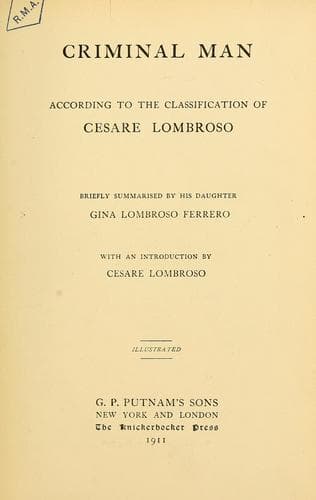
Criminal Man, According to the Classification of Cesare LombrosoLombroso, Gina
Science
Criminal Man, According to the Classification of Cesare Lombroso
Lombroso, Gina
Criminal anthropology; Criminology
When a young doctor at the Asylum in Pavia, he was requested to make a
post-mortem examination on a criminal named Vilella, an Italian Jack the
Ripper, who by atrocious crimes had spread terror in the Province of
Lombardy. Scarcely had he laid open the skull, when he perceived at the
base, on the spot where the internal occipital crest or ridge is found
in normal individuals, a small hollow, which he called _median occipital
fossa_ (see Fig. 1). This abnormal character was correlated to a still
greater anomaly in the cerebellum, the hypertrophy of the vermis,
_i.e._, the spinal cord which separates the cerebellar lobes lying
underneath the cerebral hemispheres. This vermis was so enlarged in the
case of Vilella, that it almost formed a small, intermediate cerebellum
like that found in the lower types of apes, rodents, and birds. This
anomaly is very rare among inferior races, with the exception of the
South American Indian tribe of the Aymaras of Bolivia and Peru, in whom
it is not infrequently found (40%). It is seldom met with in the insane
or other degenerates, but later investigations have shown it to be
prevalent in criminals.
This discovery was like a flash of light. "At the sight of that skull,"
says my father, "I seemed to see all at once, standing out clearly
illumined as in a vast plain under a flaming sky, the problem of the
nature of the criminal, who reproduces in civilised times
characteristics, not only of primitive savages, but of still lower types
as far back as the carnivora."
=FIG. 1
FOSSETTE OCCIPITAL
(see page 6)=
Thus was explained the origin of the enormous jaws, strong canines,
prominent zygomæ, and strongly developed orbital arches which he had so
frequently remarked in criminals, for these peculiarities are common to
carnivores and savages, who tear and devour raw flesh. Thus also it was
easy to understand why the span of the arms in criminals so often
exceeds the height, for this is a characteristic of apes, whose
fore-limbs are used in walking and climbing. The other anomalies
exhibited by criminals--the scanty beard as opposed to the general
hairiness of the body, prehensile foot, diminished number of lines in
the palm of the hand, cheek-pouches, enormous development of the middle
incisors and frequent absence of the lateral ones, flattened nose and
angular or sugar-loaf form of the skull, common to criminals and apes;
the excessive size of the orbits, which, combined with the hooked nose,
so often imparts to criminals the aspect of birds of prey, the
projection of the lower part of the face and jaws (prognathism) found in
negroes and animals, and supernumerary teeth (amounting in some cases to
a double row as in snakes) and cranial bones (epactal bone as in the
Peruvian Indians): all these characteristics pointed to one conclusion,
the atavistic origin of the criminal, who reproduces physical, psychic,
and functional qualities of remote ancestors.
Public-domain text, read in full here on John Shaqi.
Reviews
Reviews
No reviews yet
Be the first to share your thoughts on this work.
Join the Discussion
Join the discussion
Sign in to leave a comment or review.
Sign InorCreate an account