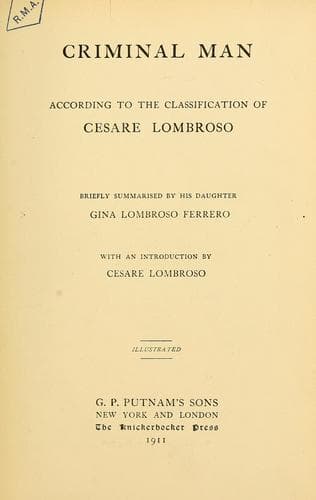
Criminal Man, According to the Classification of Cesare LombrosoLombroso, Gina
Science
Criminal Man, According to the Classification of Cesare Lombroso
Lombroso, Gina
Criminal anthropology; Criminology
After passing through a wide vestibule, I reached a large, shady
court-yard with low walls almost hidden beneath a wealth of flowers and
foliage. A corridor opening on to the court-yard was flanked on each
side by a row of open, white cells, each well lighted by a fair-sized
window during the day, and by electricity at night. Each cell is
furnished with book-shelves, a table with paper, pen and inkstand, and a
chair. All the corridors, which are gay with plants, converge towards a
central glass-room, whence the sub-inspector surveys all the radiating
corridors under his jurisdiction. Each corridor ends in a workshop,
where printing, lithography, shoemaking, metal and steel work are
carried on, and between the corridors are garden plots in which fruit,
vegetables, and flowers are cultivated. The workshops are reckoned among
the best the Republic contains. The printing-office turns out many
weekly papers, illustrated magazines, and scientific and literary
reviews. Footgear of the finest and most elegant quality is manufactured
in the shoe-factory, and the foundry and workshop produce lathes,
boilers, industrial and agricultural machines and implements. All the
cooking in the Penitentiary is done by steam, and the plant is installed
in a large building erected by the prisoners themselves.
Work in the Penitentiary is compulsory. On arrival, each convict
receives instruction in some handicraft, chosen by himself or one of the
foremen. Of course swindlers and forgers are not admitted to trades like
lithography, for reasons easy to understand.
The convicts receive regular wages which vary according to their
abilities and are about equal to the standard wages in each particular
trade. All earnings are put aside and handed to the convict on his
release when he is also provided with suitable employment.
Work is finished at five o'clock in the evening and after a substantial
supper the prisoners are divided into nine classes, six elementary and
three secondary, according to their culture and intelligence. If
illiterate, they are taught reading and writing and later, arithmetic,
geography, history, languages, and drawing,--this latter being adapted
to the particular trade of each individual. When school is finished,
prisoners are allowed to go to the library to return the books they have
read and take others for the night.
Instead of a weekly newspaper like that published at Elmira,
intellectual development is stimulated by means of lectures delivered
each week by the prisoners or their teachers and attended by the
Director, Vice-Director, and all the convicts.
Public-domain text, read in full here on John Shaqi.
Reviews
Reviews
No reviews yet
Be the first to share your thoughts on this work.
Elsewhere in the archive
Join the Discussion
Join the discussion
Sign in to leave a comment or review.
Sign InorCreate an account