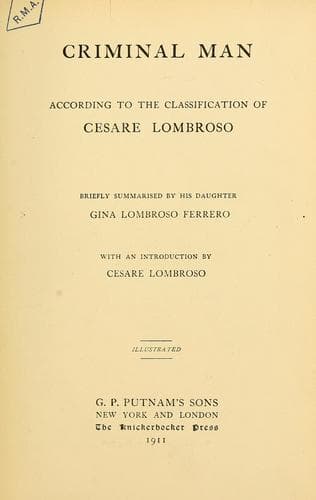
Criminal Man, According to the Classification of Cesare LombrosoLombroso, Gina
Science
Criminal Man, According to the Classification of Cesare Lombroso
Lombroso, Gina
Criminal anthropology; Criminology
In addition to the care lavished by the Director, Señor Ballvé, on the
work and education of his charges, he spares no pains to encourage moral
progress by rewarding good conduct. As each convict enters the
Penitentiary, his name, trial, sentence, and antecedents are entered in
a book with his photograph and particulars of his physical and psychic
individuality, and these data are supplemented by remarks on his conduct
and good actions, if any, so that on his release a clear idea is
obtained of the moral progress he has made while in prison.
PENAL COLONIES
When after unsparing efforts for the redemption of a criminal, repeated
convictions prove him to be a hopeless recidivist, the community should
decline to allow him to perfect his anti-social abilities at their
expense in prisons or at large, and should segregate him permanently,
unless, indeed, there is any hope of reform, or circumstances render him
harmless. Perpetual confinement in a prison, even of an improved type
is, however, both cruel and expensive, but an excellent substitute may
be found in the Penal Colony. Here the chief object should be, not to
educate, elevate, or redeem the criminal, but to render him as useful as
possible, so that he does not prove too great a burden on the community.
Penal colonies should be situated on islands or in remote territories,
that is, completely isolated from populous districts. The agricultural
colony at Meseplas founded by the Belgian Government is a model worthy
of imitation.
In this colony the convict population is divided into four categories:
1. Turbulent and dangerous individuals, who exercise an injurious
influence over the other inmates of reformatories and prisons;
2. Recidivists, ticket-of-leave men, escaped and mutinous convicts;
3. Persons of bad reputation, who have hitherto avoided conviction;
4. The better types, who have been convicted three or four times only
and although not depraved, lack moral stamina and are constantly
yielding to temptation when at large.
All the common necessities of life are supplied by the colonists
themselves, beginning with the dwellings which are erected as they are
required and according to the resources available. In this way,
extensive building operations are carried out at a very slight cost to
the State. Cattle and crops are raised on the land, which is cultivated
by a number of the convicts, while others manufacture articles which
find a ready market in the vicinity and for which they possess suitable
tools.
Any convict refusing to work is imprisoned on bread and water. All work
is paid for in special coin current only in the colony itself, but
which, on the release of the owner, is exchanged for the coin of the
country.
Public-domain text, read in full here on John Shaqi.
Reviews
Reviews
No reviews yet
Be the first to share your thoughts on this work.
Elsewhere in the archive
Join the Discussion
Join the discussion
Sign in to leave a comment or review.
Sign InorCreate an account