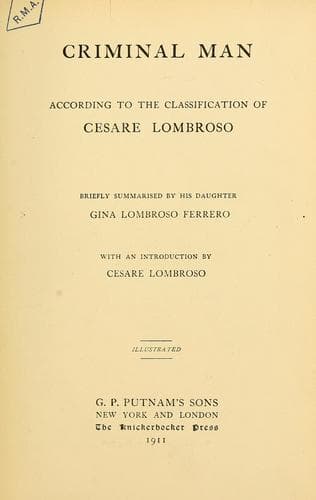
Criminal Man, According to the Classification of Cesare LombrosoLombroso, Gina
Science
Criminal Man, According to the Classification of Cesare Lombroso
Lombroso, Gina
Criminal anthropology; Criminology
The inquiry may reveal still more serious anomalies in the ideas,
intelligence, and mental condition of the patient. Sometimes the answers
given are sensible but are followed by nonsense. Other patients,
especially when afflicted with melancholia, speak unwillingly, as if the
words were forced from them, one by one. Idiots, cretins, and demented
persons are sometimes incapable of expressing themselves. Some patients
who have had apoplectic strokes substitute one word for another,
"bread" for "wine," etc., or elide one part of the sentence and only
repeat the last word.
_Memory._ To form an idea of the memory of the subject, questions should
be put to him concerning recent and remote personal facts and
circumstances, the year in which he or his children were born, what he
had for his supper on the previous evening, etc., etc.
_Visual memory_ may be tested by giving the patient a sheet of paper, on
which are drawn various common objects, letters, or easy words. He
should be allowed to look at these for five or ten seconds and requested
to enumerate them after the paper has been withdrawn. In order to test
the memory of sounds, the examiner should utter five or six easy words
and ask the patient to repeat them immediately afterwards.
To test sense of colour, a picture on which various colours are painted
is placed before the patient, as well as a skein of wool of the same
shade as one of the colours in the picture, which he is requested to
point out.
_Handwriting_ is very important, particularly in distinguishing a born
criminal from a lunatic, and between the various kinds of mental
alienation.
Monomaniacs and mattoids (cranks) who give the police the most trouble
often speak in a perfectly sane manner, but pour out all their insanity
on paper, without an examination of which it is not easy to detect
mental derangement. They write with rapidity and at great length. Their
pockets, bags, etc., are always full of sheets of paper covered with
small handwriting, sometimes scribbled in all directions. The matter is
generally absurd or simply stupid, consisting of endless repetitions.
Individuals in the first stage of paralysis make orthographical errors,
which coincide with their mistakes in pronunciation, like _Garigaldi_,
instead of _Garibaldi_. Care must be taken to test this defect
thoroughly. If the patient is fairly well-educated, his signature, which
is the last to alter, is not sufficient; nor are a few lines a
satisfactory test, since he can easily concentrate his attention on
them, but he should be requested to write a page or two and be exhorted
to make haste.
Alcoholism and paralysis generally give rise to tremulous handwriting
with unsteady strokes, as in old people. After epileptic seizures and
attacks of hysteria the writing is shaky. The slightest trembling of the
hand is detected if Edison's electric pen be used.
Public-domain text, read in full here on John Shaqi.
Reviews
Reviews
No reviews yet
Be the first to share your thoughts on this work.
Elsewhere in the archive
Join the Discussion
Join the discussion
Sign in to leave a comment or review.
Sign InorCreate an account