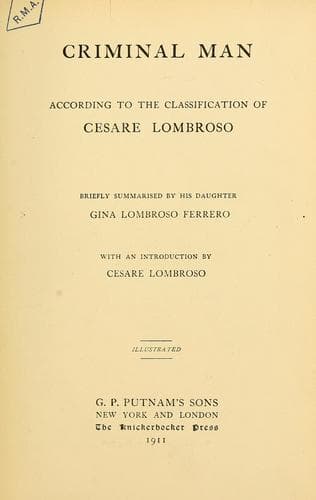
Criminal Man, According to the Classification of Cesare LombrosoLombroso, Gina
Science
Criminal Man, According to the Classification of Cesare Lombroso
Lombroso, Gina
Criminal anthropology; Criminology
In progressive general paralysis and some forms of dementia shakiness is
so excessive that it becomes dysgraphy, with zigzag letters. The
handwriting of persons subject to apoplectic strokes has often the
appearance of copper-plate. Monomaniacs intersperse their writings with
illustrations and symbols. They write very closely in imitation of
print, as do mattoids, hysterical persons, and megalomaniacs, and use
many notes of exclamation and capital letters. Their writings are full
of badly-spelled words, scrolls, and flourishes.
Criminals guilty of sanguinary offences generally have a clumsy but
energetic handwriting and cross their _t's_ with dashing strokes. The
handwriting of thieves can scarcely be distinguished from that of
ordinary persons, but the handwriting of swindlers is easier to
recognise, as it generally lacks clearness although it preserves a
certain uniformity. The signature is usually indecipherable and
enveloped in an infinite number of arabesques.
_Clothing._ The manner in which a patient is dressed often gives an
exact indication of his individuality. Members of those secret
organizations of Naples and Sicily, the Camorra and Mafia, are fond of
dressing in a loud manner with an abundance of jewelry. Murderers,
epileptics, and the morally insane, who lead isolated lives, attach no
importance to dress and are frequently dirty and shabby. (See Fig. 26,
A. D., a morally insane epileptic, the perpetrator of three murders.)
Swindlers are always dressed in faultless style, the cinædus is fond of
giving his costume a feminine air, and monomaniacs trick themselves out
with ribbons, decorations, and medals: their clothes are generally of a
strange cut. The cretin and the idiot go about with their clothes torn
and in disorder and not infrequently emit a strong odour of ammonia.
PHYSICAL EXAMINATION
Having carefully investigated the past history of the subject and made a
minute study of his abnormal psychic phenomena, the expert should
proceed to the examination of his physical characters.
Chapter I of Part I contains a detailed description of the principal
physiognomical anomalies of the criminal that may be discerned by the
naked eye. They will now be briefly recapitulated.
_Skin._ The skin frequently shows scars and (in the epileptic subject to
seizures) lesions on the elbows and temples. Marks of wounds inflicted
in quarrels and attempted suicide are frequent in habitual criminals.
The forehead and nose must be examined for traces of acne rosacea
frequent in drunkards, and for erythema on the back of the hands,
characteristic of pellagra. Ichthyosis, psoriasis, or other skin
diseases are very common in cases of mental alienation, and scurvy often
indicates long seclusion in prison.
Public-domain text, read in full here on John Shaqi.
Reviews
Reviews
No reviews yet
Be the first to share your thoughts on this work.
Elsewhere in the archive
Join the Discussion
Join the discussion
Sign in to leave a comment or review.
Sign InorCreate an account